What Is Anti Insect Net and How Does It Work
Oct 22, 2026
Every season, growers lose a quiet slice of their harvest not to disease or drought, but to insects small enough to slip past the naked eye. Aphids, thrips, whiteflies and caterpillars feed, lay eggs and spread viruses faster than most sprays can catch up. Anti insect net offers a simpler, chemical-free answer: a physical barrier that keeps pests out without keeping rain, air or sunlight out. This guide breaks down what the product actually is, the engineering behind it, and why it outperforms pesticide routines on cost, safety and crop quality.
What Is Anti Insect Net
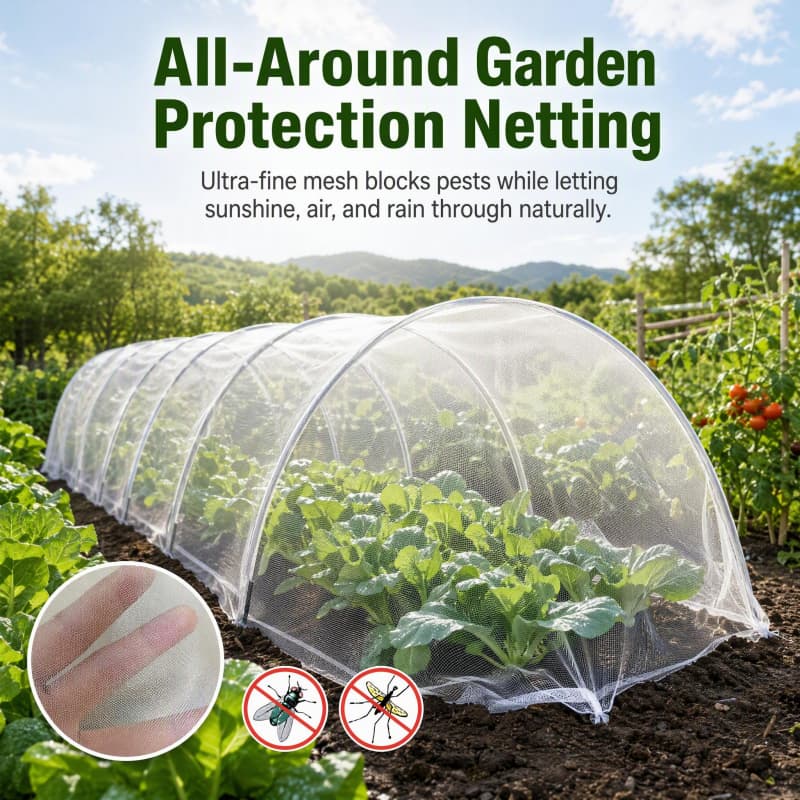
Anti insect net, also called insect netting, insect proof net or bug net, is a fine mesh fabric woven from polyethylene (PE) monofilament, designed to block insect pests from reaching crops while letting light, water and air pass through. It is stretched over greenhouses, tunnels, raised beds or whole trees to create a physical shield between the plant and the pest.
The product is not a film and not a cloth — it sits somewhere between. The mesh structure is open enough to be breathable, but tight enough to keep out target insects. Because it works by exclusion rather than by poison, it fits organic farming, seedling nurseries, fruit orchards and commercial vegetable bases alike.
How It Works
Anti insect net works on one principle: size exclusion. The mesh opening (measured in mesh count) is smaller than the body of the target pest, so the insect simply cannot pass through. Three factors make the barrier effective:
Factor
What it does
Why it matters
Mesh count
Number of threads per inch, e.g. 40 mesh, 50 mesh
Determines the smallest pest blocked; higher mesh stops smaller insects
UV-stabilized HDPE thread
Resists sunlight degradation
Keeps the barrier intact outdoors for 3–5 years
Tight installation
Net pulled taut and sealed at edges
Closes the gaps pests would otherwise find
Because the net is physical, it works 24 hours a day with no residue and no re-application. It does not rely on the pest being present to act — it prevents entry in the first place.
Mesh Size Matters More Than You Think
Choosing the right mesh count is the single most common mistake buyers make. Too fine a mesh blocks small pests but reduces airflow and light; too coarse a mesh lets the target pest through. Match the mesh to the specific insects in your region:
Mesh count
Typical opening
Blocks
Best suited for
20 mesh
~1.0 mm
Larger insects, flies, moths, birds
Orchard, fruit tree, coarse screening
32 mesh
~0.6 mm
Whiteflies, most moths
Greenhouse vegetables
40 mesh
~0.44 mm
Aphids, thrips
Tomatoes, peppers, cucumbers
50 mesh
~0.36 mm
Thrips, smaller aphids
Seedling nursery, high-value crops
60 mesh
~0.28 mm
Minute pests incl. thrips
Germination and young seedling trays
A common recommendation: 40–50 mesh for leafy vegetables and solanaceous crops, 60 mesh for seedling trays where young plants are most vulnerable to thrips.
Why Physical Barrier Beats Pesticide Routine
Growers often ask why they should switch when insecticide has worked before. The comparison rarely favours spraying:
Zero chemical residue. No withholding period, no risk of eating produce too soon after application.
No resistance build-up. Insects develop resistance to pesticides over seasons; a net does not change, so it never stops working.
One-time setup, repeated seasons. A net installed once serves multiple crop cycles, where insecticide is a recurring cost.
Broader protection. It also keeps out birds, wind-blown debris and some fungal vectors, not just insects.
Predictable cost. Upfront price is the main spend; running cost is essentially zero.
This is why organic and export-grade produce operations rely on insect netting as a first line of defence rather than a supplement to chemicals.
Material and Durability
Not all anti insect net is built the same. The quality difference sits in two areas: raw material and UV stabilisation.
HDPE (high-density polyethylene): the standard choice. It is light, tear-resistant, waterproof and holds its shape under tension.
UV-stabilised grade: added light stabilisers slow sun degradation. Plain netting can become brittle and tear within one season outdoors; a UV-stabilised version typically lasts 3–5 years under full sun.
Breathability: the open weave allows air circulation, which reduces humidity and the risk of fungal disease — an advantage sealed plastic covers cannot offer.
If the net will sit under strong sunlight or across multiple seasons, UV-stabilised HDPE is the practical choice.
FAQ
Does anti insect net block pollinators like bees?
Not necessarily. For crops that need insect pollination, choose a mesh count coarse enough (e.g. 20–32 mesh) or remove the net during the flowering window. Fine mesh blocks bees as well as pests, so plan the schedule around pollination.
Can water pass through the net?
Yes. Rain and overhead irrigation pass through the open weave freely, so you do not need to remove it for watering.
How long does HDPE insect net last outdoors?
UV-stabilised HDPE typically lasts 3–5 years in full sun; non-UV grades degrade faster, often within a single season. Durability depends on sun intensity and installation tension.
Can I cut anti insect net to a custom size?
Yes. It cuts cleanly with scissors or a hot knife, and edges can be heat-sealed or taped to prevent fraying.
Is anti insect net the same as mosquito net?
No. Mosquito netting is finer, designed for home windows, and too dense for good greenhouse ventilation. Anti insect net is optimised for crops: balanced mesh, UV resistance and outdoor durability.
Read More


 IPv6 network supported





 English
 español