Shift Your Orchard Risk From Reactive Repair To Planned Protection
Oct 23, 2026
Hail risk is a strange problem in commercial farming. Most growers accept it as random bad luck. They buy insurance, cross their fingers, and scramble to clean up after a storm hits. But this mindset locks your harvest into uncertainty year after year.
Anti hail net is not just another farm accessory. It is a risk-transfer tool built into your orchard layout. Instead of responding to damage after it occurs, you set up a passive overhead buffer that activates the moment hail starts falling. It does not eliminate extreme weather, but it removes the all-or-nothing gamble that defines hail-prone growing regions.
Many first-time buyers make the same mistake: they compare anti hail nets only by price per roll. Two nets can look almost identical in photos, yet behave completely differently under real hail impact, wind load, and multi-year sun exposure. The difference sits in yarn formulation, knitting structure, edge reinforcement, and how the whole net interacts with your support frame. This post breaks down the decision framework from a farm operation perspective, not just a product feature list.
The core logic: Anti hail net works through controlled deflection, not rigid blocking
A common misunderstanding is thinking the net “catches” hailstones like a bucket. That is not how it functions.
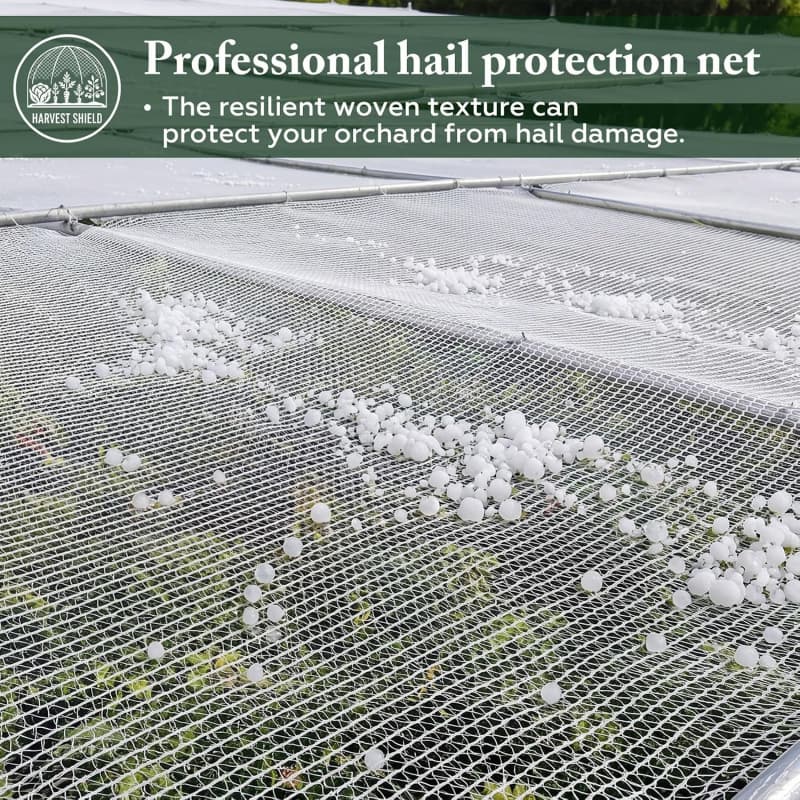
When a hailstone drops at high speed, the knitted mesh yields slightly, stretches locally, and disperses kinetic energy across many adjacent yarns. The stone either bounces away or fractures into tiny fragments with too little remaining force to injure fruit, leaves or young branches. The mesh recovers its shape afterward, ready for the next storm.
This flexible response is why anti hail net cannot be replaced by shade net, bird net or plastic film. Shade net is designed to filter light; its yarn is thinner and it lacks the elastic recovery needed for impact. Bird net uses fine openings and low tensile strength; it tears quickly under hail. Plastic sheeting stops hail but traps heat, blocks rain and airflow, and creates a hostile microclimate under the cover.
A well-engineered anti hail net strikes a narrow balance: strong enough to absorb impact, open enough to keep the canopy breathing, light enough for practical handling and installation.
The hidden economic value most buyers overlook
The clearest return on anti hail net comes from avoiding catastrophic fruit loss. But the real financial benefit unfolds in quieter ways across your farm operation.
First, it stabilizes your sales grade profile. Premium fresh fruit markets penalize even tiny surface marks. One hailstorm can push a large share of your harvest from export grade down to processing grade, cutting revenue drastically. With consistent protection, you can lock in pre-season buyer contracts with more confidence, because you can reliably commit to quality standards.
Second, it smooths your annual maintenance budget. Unprotected orchards face unpredictable costs: broken branch pruning, disease entry points from wounded tissue, replanting of young trees, and extra labour for sorting out damaged fruit. These costs do not show up on your material quote sheet, but they pile up fast after a bad storm.
Third, it reduces secondary stress on trees. Hail wounds are easy entry points for bacteria and fungi. A net that limits physical bruising also lowers disease pressure and reduces the need for emergency spray schedules after storm events.
And finally, the same net brings secondary weather buffering. It softens gusty wind, reduces direct sun radiation on fruit skin, and discourages bird feeding during ripening windows. These gains are side effects, not the primary purpose, but they add measurable value in mixed-risk zones.
What to assess when comparing anti hail net options
When you evaluate samples from suppliers, move past “gsm only” comparison. Four factors together determine real-world performance.
1. Raw polymer base and UV package
Virgin HDPE is the baseline for consistent performance. Recycled HDPE blends contain inconsistent contaminants, which create weak spots in individual yarns. Even if the gsm reads the same on a scale, recycled net can develop brittle lines and split open after one or two seasons.
UV stabilizer loading is not a single standard. Nets sold for inland high-UV zones require a different additive package than nets for cooler, cloudy hail zones. A supplier that only quotes a generic “UV treated” label without linking expected service life to your local climate is giving you incomplete information.
2. Knitting structure and load distribution
Knotless construction delivers a smooth surface that reduces rubbing abrasion on fruit when the net shifts in wind. This is the preferred style for high-value cherry, apple and table grape blocks. Knotted net has locked intersections and higher resistance to tearing once a cut starts, making it better for sites with heavy wind, snow load, or rough seasonal handling.
Neither version is universally better. The right choice depends on what stress your location puts on the net most often: fruit contact abrasion, or high tensile pull.
3. Mesh opening size and light trade-off
Smaller openings improve hail interception but reduce light transmission. Larger openings preserve more sunlight and airflow yet leave you exposed to smaller damaging hail. There is no perfect mesh size for every crop.
Light-sensitive varieties that need full colour development cannot tolerate overly dense mesh. Crops already fighting frequent sunburn can accept a slightly tighter mesh to gain dual protection. This is why a supplier should ask for your crop variety and typical hail size distribution before recommending a specification.
4. Edge finishing
Plain-cut edges are the weakest point of any net roll. Under tension, tears start at the edge and run rapidly across the mesh. Reinforced rope-in hems distribute pulling force evenly across anchor points. If you plan to install and remove the net year after year, reinforced edges are not an upgrade — they are a necessity.
Fit the net system to your farm rhythm
Anti hail net works best when you integrate it into your growing calendar, not treat it as a last-minute emergency cover.
For most deciduous fruit, the critical protection window opens after fruit set. Once young fruit forms, bruising risk begins. Installing too early can interfere with pollinator movement; installing too late leaves you exposed if an early hail event arrives. After harvest, you can roll the net away for storage if your frame system is designed for seasonal operation, or leave it mounted permanently for high-risk areas.
Frame design matters as much as the net itself. The net must hang freely above the canopy. If it lies directly on branches, hail energy transfers through the mesh into the fruit underneath, and wind movement creates constant rubbing damage. Sloped frames work better than flat tops because they shed rain and melted hail, avoiding heavy static load that can break fixings or stretch the mesh permanently.
Routine checks follow storm seasons. Look for small snags and nicks before they turn into large rips. A tiny repair takes minutes; a full panel replacement costs hours of labour and material.
Who gets the strongest ROI from anti hail net?
Anti hail net makes the most sense for operations built around high-value fresh market fruit. Cherry orchards are a classic fit because cherry skin is extremely fragile. Wine and table grape growers also benefit heavily, since berry damage ruins both appearance and fermentation quality. Apple, pear, stone fruit, citrus and kiwi operations in hail corridors see clear returns.
It is less common for low-margin bulk field crops, where the cost of frames and netting cannot be justified against commodity pricing. For these growers, alternative risk strategies may remain more economical.
Closing
Modern commercial farming is increasingly about managing volatility. Hail will not disappear, but you do not need to build your business around surviving its random hits. Anti hail net gives you a predictable layer of control that aligns with long-term orchard planning.
The best anti hail net purchase is not the cheapest roll you can source. It is a matched system: yarn spec, knit style, mesh dimension, edge treatment, frame layout and maintenance plan tailored to your crop and local weather patterns. When you get that combination right, you stop gambling on hail seasons and start protecting the harvest you have worked all year to grow.
Read More


 IPv6 network supported





 English
 español