Enter product details (such as color, size, materials etc.) and other specific requirements to receive an accurate quote.

leave a message

If you are interested in our products and want to know more details,please leave a message here,we will reply you as soon as we can.
Submit
other

agricultural shade net

Home Blogs

agricultural shade net

  • Aluminum Shade Net vs Regular HDPE Shade Net: How to Pick the Right Shade Mesh for Your Project
    Aluminum Shade Net vs Regular HDPE Shade Net: How to Pick the Right Shade Mesh for Your Project
    Oct 20, 2026
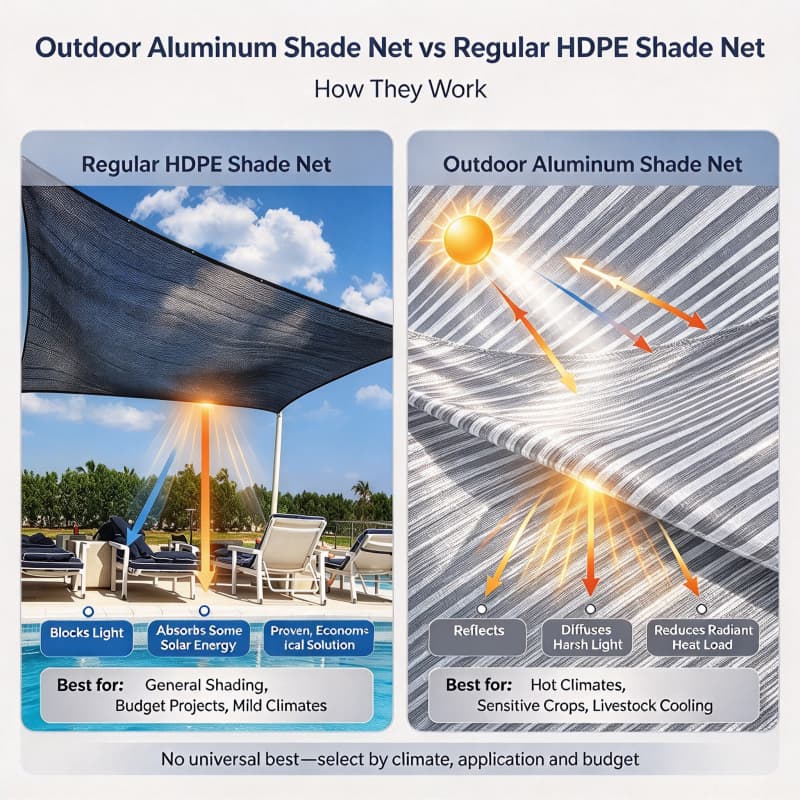
    Introduction   When planning outdoor shading for greenhouses, patios, livestock barns or construction sites, shade net is one of the most cost-effective solutions. Two mainstream options dominate the market: aluminum reflective shade net and regular HDPE shade net. A common misunderstanding is that one type is universally “better”. In reality, each works on a different physical principle and fits distinct project priorities. We supply both aluminum shade net and standard HDPE shade net. Our goal here is to lay out factual differences, so distributors, farmers and contractors can select based on climate, crop type, budget and expected service life.   How They Work: Core Principle Difference   Regular HDPE Shade Net   Standard shade net is knitted from HDPE yarn mixed with UV stabilizers. It works by absorbing sunlight and blocking a set percentage of light. The fabric absorbs solar energy and releases part of that heat into the space underneath. It is a mature, proven shading solution widely used globally for decades.   Outdoor Aluminum Shade Net    Aluminum shade net uses UV-stabilized HDPE base mesh bonded with aluminum reflective filaments. Instead of absorbing solar heat, it reflects infrared radiant heat and UV back to the atmosphere. It still filters light, but creates a cooler microclimate by reducing radiant heat load, while diffusing harsh direct sunlight into soft, even light. It also offers mild heat retention overnight in greenhouse applications.   Side-by-Side Comparison Table   Comparison Item Regular HDPE Shade Net Outdoor Aluminum Shade Net Working Mechanism Absorbs sunlight to block light; some heat re-radiates downward Reflects infrared & UV radiation; diffuses incoming light Cooling Performance Provides shade; temperature drop is limited Superior radiant heat reduction; noticeably cooler under the net under strong sun Light Quality Creates sharp shadows; light distribution less uniform Soft diffused light; fewer hot spots, better for sensitive crops Material & Structure Pure HDPE knitted mesh HDPE base + aluminum reflective coating/filaments Upfront Cost Lower Higher Service Life Good with virgin HDPE and UV additives Long service life in hot high-radiation areas; aluminum layer needs protection from heavy abrasion Night Thermal Performance No thermal retention Minor heat retention for greenhouse overnight Best Fit Temporary shading, low-budget projects, mild climates, general shading Hot climates, temperature-sensitive crops, livestock cooling, premium patio & long-term commercial shading   Benefits & Limitations of Regular HDPE Shade Net   Strengths   Budget-friendly for large-area or short-term shading projects   Simple product with stable supply and easy installation   Wide range of shade rates and colors (black, white, green)   Good tensile strength and wind resistance for general use   Easy to cut, re-use and store for seasonal jobs   Limitations   Absorbs heat, so under-canopy temperature rises more in extreme heat   Creates concentrated shadow areas, may cause sunscald on delicate crops   Benefits & Limitations of Outdoor Aluminum Shade Net   Strengths   Reflective cooling: same shade rate delivers stronger temperature reduction in intense sunlight   Even diffused light reduces hot spots and crop sunburn   Blocks UV while maintaining airflow   Dual function: daytime cooling + slight night heat preservation for greenhouses   Ideal for high-value crops, animal heat stress relief and residential patio comfort   Limitations   Higher initial investment compared with standard HDPE shade net   Aluminum reflective surface can wear if subject to heavy friction or sharp abrasion   Metallic silver appearance may not fit every landscape aesthetic preference   How to Choose: When to Pick Which   Choose Regular HDPE Shade Net if:   You have a tight budget or temporary shading (construction covering, seasonal event shading)   Your local climate has mild summers without prolonged extreme heat   You need simple light blocking for hardy plants, general farm coverage   Large area coverage where upfront cost is the primary deciding factor   Choose Outdoor Aluminum Shade Net if:   Projects located in hot, high UV regions where radiant heat is a major concern   Greenhouse cultivation for sensitive, high-value crops (nursery seedlings, flowers, berries)   Livestock barns, poultry houses to reduce heat stress and protect animal productivity   Residential pergolas, carports, pool areas where human comfort is key   Long-term fixed installations, and you want to lower ongoing crop/asset heat damage   Frequently Asked Questions   Q1: For the same shade percentage, will aluminum shade net always be cooler? A1: Yes for radiant heat. Under strong direct sunlight, aluminum shade net delivers better cooling effect. But airflow, installation gap and local weather also affect the final temperature. Regular HDPE shade net still works reliably for basic shading.   Q2: Can I mix the two types in one greenhouse project? A2: Absolutely. Many clients combine them: use aluminum shade net for sensitive crop zones and standard HDPE shade net for outer roof or low-priority areas to balance performance and budget.   Q3: Are both products customizable? A3: Yes. We supply custom width, length, shade rate, reinforced edges and grommet options for both regular HDPE shade net and aluminum shade net.   Q4: What about wind resistance? A4: Both are breathable knitted mesh and suitable for outdoor wind conditions. Proper tension and mounting are critical regardless of the shade net type you select.   Conclusion   There is no universal “best” shade net, only the most suitable one for your specific project. Regular HDPE shade net remains a practical, economical staple for most standard shading needs. Aluminum shade net is a performance upgrade, designed specifically for hot climates and applications where precise temperature control matters.   We carry both product lines. Share your location, application, shade rate requirement and budget, and our team can recommend the optimal mesh solution for wholesale or project orders.
    Read More
  • Why 60% Shade Net Is The Most Versatile Shading Choice For Growers
    Why 60% Shade Net Is The Most Versatile Shading Choice For Growers
    Oct 19, 2026
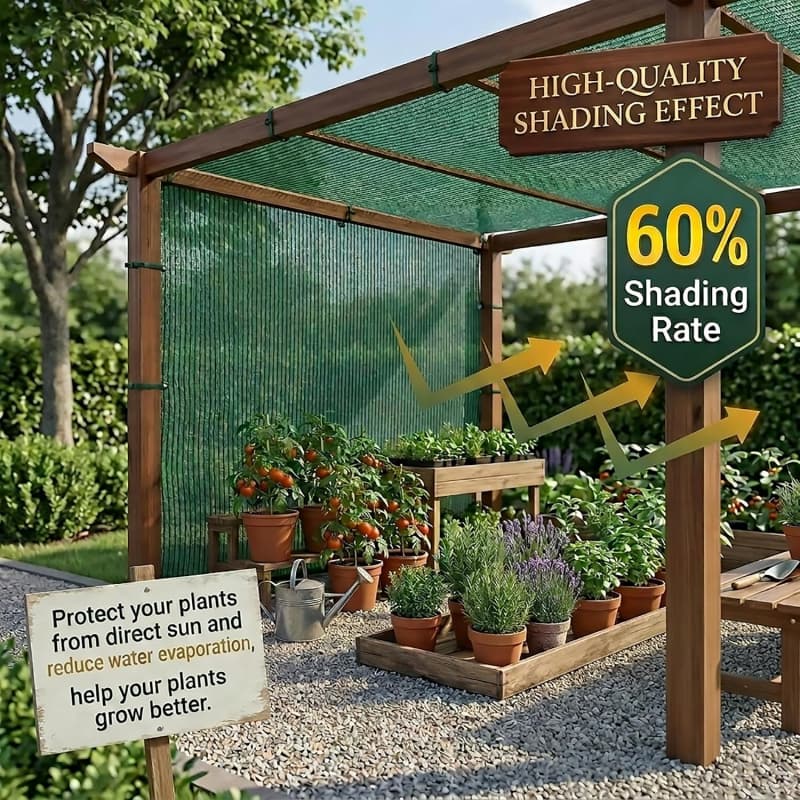
    Choosing the correct shade rate can make or break your growing season. Many growers either pick 30% shade net which offers barely enough heat relief in hot summers, or jump straight to 70%–80% heavy shade net that limits photosynthesis and leaves plants weak and leggy.   If you are searching for a balanced shading solution that cuts harsh sun without starving plants of light, 60% shade net is your sweet spot. It has become the go-to choice for commercial nurseries, vegetable farms, orchard operators, livestock owners and home gardeners worldwide.   What Exactly Is 60% Shade Net?   60% shade net blocks 60% of direct sunlight and harmful UV radiation, while letting 40% soft diffused light pass through. Made from UV-stabilized virgin HDPE yarn with raschel warp-knitted structure, this mesh does not fully darken the covered area. Instead, it scatters harsh direct sunlight into gentle diffused light.   Unlike solid tarps that trap heat and stop airflow, shade net remains permeable. Air and rain can freely flow through the mesh openings, preventing overheating and water pooling underneath.   The Top Benefits of 60% Shade Net   1. Prevents leaf burn while maintaining healthy plant growth   Strong midday sun easily scorches tender seedlings, leafy greens and ornamental flowers. The 60% shading level shields foliage from UV damage. Meanwhile, the remaining 40% transmitted light is sufficient for photosynthesis. This avoids the common issue of elongated, weak stems caused by over-shading.   2. Reduces ambient temperature and saves water   Direct sunlight heats soil rapidly and speeds up moisture evaporation. When covered with 60% shade net, the microclimate under the cover stays several degrees cooler. Less soil drying means you can cut down irrigation frequency and reduce water costs, a huge advantage for large-scale farms in hot and arid regions.   3. Durable outdoor performance for year-round use   Our 60% HDPE shade net mixes UV masterbatch into yarn, not just surface coating. It resists aging, fading and brittleness under long-term outdoor exposure. The lock-stitch knitted design stops the mesh from unraveling even after small tears, delivering excellent tear and wind resistance.   4. Multi-scene application beyond plant growing   60% shade net is not limited to greenhouses and nurseries:   Livestock shelters: Protect cattle, chickens and other animals from heat stress in summer   Orchards & berry farms: Shield fruit from sunscald   Residential patios, carports: Create comfortable shaded outdoor leisure zones   Construction sites: Temporary UV protection for workers and materials   Which Crops Suit 60% Shade Net Best?   This shade rate works wonderfully for crops that prefer partial sunlight:   Seedlings, saplings and young plants   Leafy vegetables: lettuce, spinach, herbs   Ornamental plants: ferns, anthurium, orchids   Berries and young fruit trees   Tip: High-light crops such as tomatoes and peppers usually require lower shade rate (30%-40%). For full-shade plants like mushrooms, choose 70%+ shade net.   Key Buying Checklist Before You Order 60% Shade Net   1.Confirm the shade rate tolerance: Reliable manufacturers keep tolerance within ±5%   2.Check raw material: Virgin HDPE with UV additives lasts much longer than recycled material   3.Choose finishing: Reinforced hems and grommets are recommended for repeated installation   4.Measure your frame: Calculate width and length accurately; leave extra margin for tensioning.   Simple Installation Tips   Stretch the net moderately; avoid excessive tension which may damage the mesh in strong winds.   Keep a gap between the net and plant canopy to retain airflow.   Secure firmly onto posts, cables or greenhouse frames.   Clean and dry the net fully before storage to extend service life.   Final Thoughts   Shade net is never a one-size-fits-all product. Among all available shade rates, 60% strikes an ideal balance between sun protection and light transmission. It solves heat stress and sunburn problems without sacrificing plant vitality.   Whether you run a commercial nursery, manage a farm, or just want a shaded patio space, 60% HDPE shade net delivers reliable, cost-effective protection for all your outdoor projects.   If you need custom sizes, colors or pre-grommeted panels, contact our team for wholesale quotations and samples.   \  
    Read More
  • The Philippines Safety Net
    The Philippines Safety Net
    Feb 05, 2026
    The philippines safety net that is different with the others, as the safety net is material HDPE Materil  size 2.5m*90m  weight is 120gsm or 90gsm  size 2.35M*30M 60gsm with the small hole mesh  color:green ,black and so on  package is one rolls or the bag package   
    Read More
  • Where is agriculture shade net will be use ?
    Where is agriculture shade net will be use ?
    Feb 05, 2026
    The sun shade net of the polyethylene dust-proof cover net manufacturer has the characteristics of strong tensile strength, aging resistance, corrosion resistance, radiation resistance, and simplicity. Moreover, the price of the sunshade net is not high. It is deeply loved by consumers and is more used in agriculture. Is extensive.    Sun shade nets are mainly used for the protective cultivation of vegetables, Xianggu, flowers, edible fungi, seedlings, medicinal materials, ginseng, Ganoderma lucidum and other crops, as well as aquatic and poultry farming, and have a significant effect on improving production. Generally, the leafy vegetables grown in winter and spring directly cover the surface of the leafy vegetables with a shading net to prevent low temperature hazards. Because of its light weight, only 45 grams per square meter dominates, and it does not affect the grown tall leafy vegetables. Overwhelming, bending, and lowering the commodity. Polyethylene dust-proof soil net manufacturers also have certain air permeability, and the surface of the leaves is still dry after being covered, which reduces the occurrence of diseases. It also has a certain light transmittance, and it will not cover up yellow and rotten after being covered up. we also call the sun shade net or sun shade mesh or agriculture sun shade net.  
    Read More
  • Where and how to use shade net
    Where and how to use shade net
    Feb 04, 2026
    Shading nets are mainly used in summer, especially in the South where they are widely promoted. Some people describe it as white in winter in the north (covered by the film), and black in summer in the south (covered with shading nets). The use of sunshade nets to cultivate vegetables in the south in summer has become a major technical measure for disaster prevention and protection. Northern applications are also limited to summer vegetable seedlings. In summer (June-August), the main function of covering the sunshade net is to prevent the scorching sun, the impact of heavy rain, the hazard of high temperature, the spread of pests, and especially play a good role in preventing the migration of pests.After covering in summer, it plays a role of blocking light, raining, moisturizing, and cooling; after covering in winter and spring, it also has a certain function of heat preservation and humidification.Moisturizing principle: After covering the sunshade net, because of the cooling and windproof effect, the communication speed between the air in the covered area and the outside world is reduced, and the relative humidity of the air is obviously further increased. At noon, the humidity increase value is the largest, generally reaching 13-17%, and the humidity is high. The amount of soil evaporation decreases, increasing the soil moisture.The sunshade net is made of polyethylene (HDPE), high-density polyethylene, PE, PB, PVC, recycled materials, new materials, polyethylene propylene, etc. as raw materials. After UV stabilizer and anti-oxidation treatment, it has strong tensile strength, It has the characteristics of aging resistance, corrosion resistance, radiation resistance and lightweight. It is mainly used for the protective cultivation of vegetables, Xianggu, flowers, edible fungi, seedlings, medicinal materials, ginseng, Ganoderma lucidum and other crops and aquatic and poultry breeding industry, etc., and has obvious effects on increasing output.  
    Read More
  • 140g Shade net.
    140g Shade net.
    Nov 06, 2025
    140g shade net is made of highly-durable polyethylene material, which can effectively resist all kinds of severe weather. Shade net is made of polyethylene (HDPE) material by adding UV stabilizers and anti-oxidants. HDPE sunshade net has the characteristics of lightweight, high-strength, anti-aging, large-area coverage and it has the ability to adjust control environment, optimizing climate and improve plants in the growth of adverse climate conditions. Shade Net is mostly used in agriculture as ventilate shade net for greenhouse, offering the features of light reflection and transmission, breath freely, long usage life and stable performance. --Material: Shade Net is made of highly-durable polyethylene material, which can effectively resist all kinds of severe weather; The surface is smooth to touch and the material is light enough to fold and store; With the help of this cloth, your plants can live a longer and stronger life. --Excellent Craftsmanship: The shade cloth is breathable, durable, and will last throughout the seasons; All edges are double-stitched to prevent fraying or distorting edges. -Easy to Use: you can hang our sunshade freely and easily without worrying about it getting torn.Both sides of the mesh fabric are woven with keyholes for easy installation. --Several Applications: shade net can protect your family, animals, and plants from the sun; Create a shade in your yard, patio,open garage, garden, or pool; You can also combine multiple shades of different sizes to cover larger areas. --Widely Used: Widely used on greenhouse vegetables, flowers, fruit tree seedlings, edible fungi culture and farms, cooling of open-air operations, covering the sunshade net in winter can also play a role in heat preservation and humidification. --Breathable and Protective:This shade cloth will block out 30%-98% of the sun's rays and most sunlight, creating a cool, relaxing shade under the hot sun; The breathable material will allow air to travel through the cloth. Material 100%HDPE+UV Weight 140g Shade Rate 80% Color Green, Blue, and so on Size 3m*50m,4m*100m, as your request      
    Read More
  • The Ultimate Solution for Sun Protection.
    The Ultimate Solution for Sun Protection.
    Sep 05, 2025
    Discover the Ultimate Solution for Sun Protection: Our Premium Shade NetsHello there, dear readers! I'm excited to bring you insights and information straight from the world of shade nets, as a proud supplier in this field.The Importance of Shade NetsIn various settings, the sun's intense rays can pose challenges. Whether it's protecting your crops from scorching heat, providing a comfortable outdoor space for relaxation, or safeguarding industrial areas, shade nets play a crucial role. They offer an effective and efficient way to manage sunlight while providing numerous benefits.Our High-Quality ProductsAt our company, we take pride in offering top-notch shade nets that meet the diverse needs of our customers. Our shade nets are made from premium materials that ensure durability and longevity. They are carefully crafted to provide optimal shade while allowing adequate air circulation. This is essential for maintaining healthy plant growth and creating comfortable environments.Our product range includes different shades and densities to cater to specific requirements. From light shade nets that allow some sunlight to penetrate for delicate plants, to heavy-duty options for industrial applications, we have it all. Whether you need protection for your garden, greenhouse, patio, or construction site, our shade nets are the perfect solution.Benefits of Using Our Shade Nets- Plant Protection: Our shade nets can significantly reduce the risk of sunburn and heat stress on plants. They help maintain the ideal temperature and humidity levels, promoting better growth and higher yields.- Energy Savings: By providing shade, our nets can help reduce the need for artificial cooling in buildings and outdoor areas, leading to energy savings.- UV Protection: Our products offer excellent protection against harmful ultraviolet rays, preserving the quality and longevity of the items they cover.- Versatility: Our shade nets can be used in a wide range of applications, including agriculture, horticulture, landscaping, and industrial settings.Why Choose Us?- Expertise: With years of experience in the industry, we have the knowledge and expertise to provide you with the best solutions for your shade needs.- Quality Assurance: We strictly adhere to quality control standards to ensure that our products meet the highest levels of excellence.- Customer Satisfaction: Our top priority is customer satisfaction. We are committed to providing exceptional service and support to ensure that you are completely satisfied with your purchase.- Competitive Pricing: We offer competitive prices without compromising on quality. Our goal is to make high-quality shade nets accessible to everyone.How to OrderOrdering from us is a breeze. Simply visit our website or contact our sales team for more information. We offer a wide range of sizes and customization options to meet your specific needs.ConclusionIn conclusion, shade nets are an essential tool for managing sunlight and providing protection in various settings. As a trusted supplier, we are dedicated to providing you with the highest quality shade nets that will meet your needs and exceed your expectations. Choose us for your shade net solutions and experience the difference.Thank you for reading our blog. We look forward to serving you and helping you achieve your goals.Best regards, Jelly  
    Read More
  • Sun shade nets with different shading rates are suitable for different crops.
    Sun shade nets with different shading rates are suitable for different crops.
    Mar 21, 2025
    Shade nets with different shading rates are used in agriculture to optimize plant growth and protect crops from excessive sunlight. Here’s how various shading rates are suited for different agricultural applications: 1. 30%-50% Shading Rate Best for: Light-sensitive crops that require partial sunlight. Applications: Vegetables: Lettuce, spinach, and other leafy greens. Flowers: Orchids, roses, and other ornamental plants. Nurseries: Young plants or seedlings that need gentle sunlight for healthy growth. 2. 50%-70% Shading Rate Best for: Crops that thrive in moderate shade and need protection from intense sunlight. Applications: Fruits: Strawberries, grapes, and blueberries. Vegetables: Tomatoes, peppers, and cucumbers. Herbs: Basil, mint, and cilantro. Greenhouses: To reduce heat and prevent sunburn on plants. 3. 70%-90% Shading Rate Best for: Shade-loving plants or crops that require minimal direct sunlight. Applications: Ornamental Plants: Ferns, palms, and other shade-loving species. Medicinal Plants: Ginseng, turmeric, and other herbs that grow best in low light. Livestock: Providing shade for animals in pastures or barns. 4. 90% and Above Shading Rate Best for: Specialized applications where maximum shade and protection are needed. Applications: Storage Areas: Protecting agricultural equipment or produce from sun damage. High-Heat Regions: Creating ultra-shaded environments for sensitive crops or livestock. Key Benefits of Using Shade Nets in Agriculture: Temperature Control: Reduces heat stress on plants. UV Protection: Shields crops from harmful ultraviolet rays. Water Conservation: Lowers evaporation rates, saving water. Pest Protection: Acts as a barrier against insects and birds. Improved Yield: Creates optimal growing conditions for better crop quality and quantity. By selecting the right shading rate for your crops, you can enhance growth, protect plants, and maximize agricultural productivity.              
    Read More

leave a message

leave a message
If you are interested in our products and want to know more details,please leave a message here,we will reply you as soon as we can.
submit

Home

Products

whatsApp

contact