Enter product details (such as color, size, materials etc.) and other specific requirements to receive an accurate quote.

leave a message

If you are interested in our products and want to know more details,please leave a message here,we will reply you as soon as we can.
Submit
other

Blog

Home Blogs

Blog

  • Modern Outdoor Decor Ideas with Grey White Striped Privacy Fence Screen
    Modern Outdoor Decor Ideas with Grey White Striped Privacy Fence Screen
    Oct 30, 2026
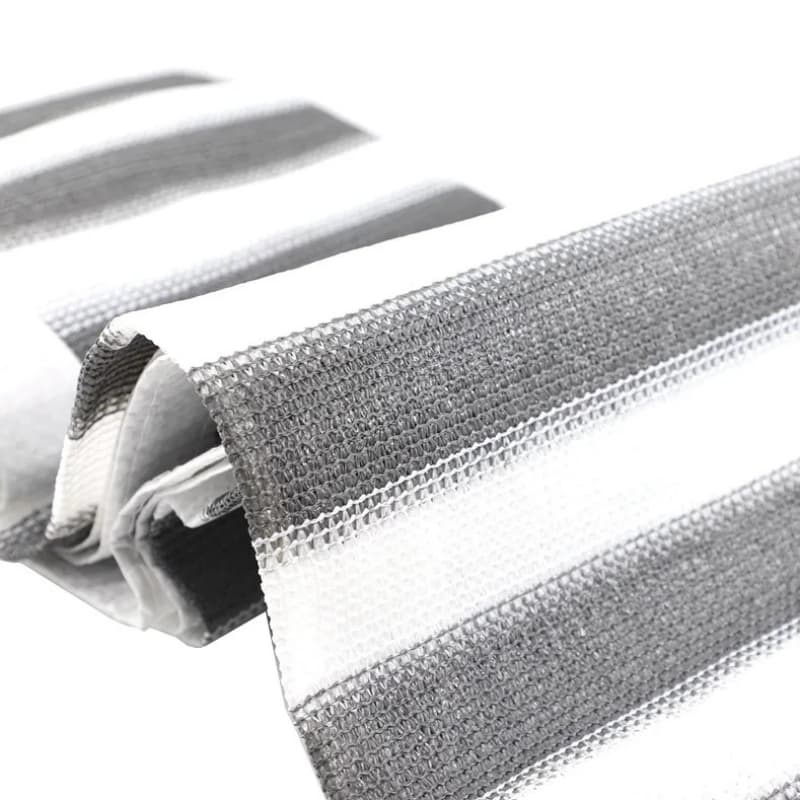
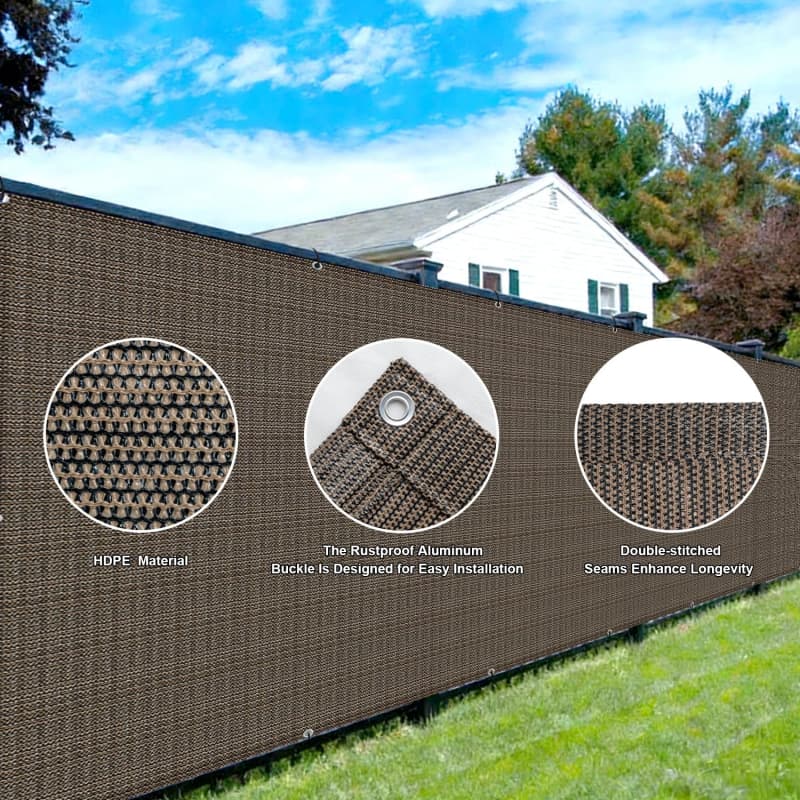
    Grey white striped privacy fence screens are far more than a simple privacy solution. While solid privacy screens get the job done, they often look plain and heavy. The soft grey and white horizontal stripes bring a clean, modern touch, blending privacy, airflow and decorative style perfectly. Made of UV-stabilized HDPE, this screen works beautifully for many outdoor layouts, from small city balconies to spacious backyard decks.   If you are tired of boring backyard fencing and want an affordable refresh, keep reading. We share seven creative ways to style grey white striped privacy fence screen and elevate your outdoor area. 1. Modern Balcony Privacy for Urban Apartments   City balconies usually sit close to neighbours. A grey white striped screen is ideal here. The light stripe pattern will not make your small balcony feel dark or cramped like a dark solid screen. It blocks direct sight from adjacent units while letting fresh wind pass through. Match it with grey planters, outdoor cushions and green potted plants for a minimalist Scandinavian vibe. You can mount it along the full balcony railing or only on the side facing neighbours.   2. Backyard Fence Upgrade for Wooden Fences   Natural wood fences look warm but sometimes lack privacy. Attaching our grey white striped screen over the existing wooden fence creates a fantastic contrast. The neutral grey-white stripes balance the warm wood tone. It hides gaps between wooden slats without covering the whole natural look of your fence. It is a budget-friendly renovation choice, no need to replace the whole fence. Great for family yards, pet play areas and casual outdoor lounging zones.   3. Deck & Patio Partition   Open decks often feel exposed. You can use the striped screen as a lightweight partition instead of building a permanent wall. Separate your dining corner from the hot tub area or create a quiet reading nook on the deck. The horizontal stripes visually widen the space. Since the HDPE mesh is breathable, it will not catch strong wind and cause damage. Adjust the height freely to get the exact privacy level you want.   4. Pool Side Screening   Pool areas need privacy and good weather resistance at the same time. Bright solid screens can reflect too much sunlight, while dark ones absorb heat. Grey white stripes offer a gentle, refreshing look beside the pool. The UV-resistant material stands up to splashing water, strong sun and humidity. It hides the pool area from street view and keeps your pool zone calm and resort-style.   5. Pergola Side Curtain   Many homeowners use pergolas for shade, but the open sides still lack privacy. Hang the grey white striped privacy screen on pergola sides. It acts like an outdoor curtain. You can fix it permanently with grommets and zip ties, or make it removable. On sunny days, it filters harsh sunlight; on breezy days, air flows through freely. It works well for outdoor dining pergolas and outdoor bar areas.   6. Side Yard Screening & Utility Hideaway   Side yards often hold garbage bins, air conditioners, garden tools and hose reels. These items ruin your curb appeal. Cover the utility zone with grey white striped fence screen. The neat stripe pattern hides messy equipment and matches most house exteriors. It is lightweight, easy to install and much cheaper than building a solid privacy wall.   7. Temporary Screening for Outdoor Events   If you host garden parties, small weddings or backyard gatherings, this striped screen is a wonderful decorative backdrop. It creates a clean photo background and separates the event area from the rest of the yard. It is reusable and portable. After the party, you can take it down, roll it up and store it for next time.   Tips to Match Grey White Striped Privacy Screen Better   Pair it with neutral colours: grey, black, teak wood, light beige furniture for a harmonious look   Add greenery: climbing vines, potted palms and shrubs soften the linear stripe design   Do not cover the whole fence: partial coverage creates a more layered designer look   Choose the right shade rate: 75% shade rate keeps more light; 85%-90% gives stronger privacy   Final Thoughts   The grey white striped privacy fence screen is a versatile outdoor decor pick. It breaks the monotony of traditional privacy netting. Whether you live in an apartment with a tiny balcony or own a large backyard, it adds privacy, airflow and modern style at a low cost. We support custom sizes, reinforced hems and metal grommets for easy installation. Contact us for samples and wholesale pricing.   FAQ   Q: Will the grey white stripe pattern fade quickly outside? A: Our HDPE screen is added with UV stabilizer. It resists fading under long-term sun exposure for years.   Q: Can I cut the screen to fit my custom space? A: Yes, you can trim it with scissors. We recommend sealing the cut edge to prevent fraying.   Q: Is this striped screen windy-friendly? A: Yes, the woven mesh structure allows wind to go through, reducing wind load compared to solid tarps.  
    Read More
  • Solid Privacy Tarps Are Not The Best Pick — Here’s Why Breathable Striped Mesh Privacy Screens Win
    Solid Privacy Tarps Are Not The Best Pick — Here’s Why Breathable Striped Mesh Privacy Screens Win
    Oct 29, 2026
    If you’re shopping for outdoor privacy, solid tarps often pop up first. They seem cheap and convenient, but they come with obvious drawbacks that ruin your outdoor experience. Today we break down the problems of solid tarps, and explain why our green & white striped mesh privacy fence screen is a better solution.   The Main Downsides of Solid Privacy Tarps   Catches wind like a sail Flat solid fabric bears the full force of wind. Strong gusts can tear the tarp, pull out grommets, or even damage your fence posts.   Traps heat, creates a stuffy space No air can pass through. Hot air gets locked behind the tarp, turning your balcony or patio into a hot, stagnant corner in summer.   Bland & industrial-looking Most solid tarps are plain dark colours. They look like temporary construction covers and ruin the vibe of your garden.   Slow to dry, easy to grow mildew Rainwater pools on the surface. Moisture stays trapped, leading to mould, odour and shorter service life.     Why Our Green White Striped Mesh Privacy Screen Outperforms Tarps   Privacy + airflow, no compromise The tightly knitted HDPE mesh blocks sightlines from neighbours and passers-by. Meanwhile, porous holes let fresh breeze flow through. Wind pressure is greatly reduced, so the screen is far less likely to rip.   Decorative striped design, not just a functional barrier Unlike boring solid black or dark green screens, the horizontal green-white stripes match lawns, plants, patio furniture and pool areas. It covers ugly chain-link fences, AC units and clutter while acting as outdoor decor.   UV-stabilized virgin HDPE for all-weather durability UV inhibitors are mixed into the raw material, not only coated on the surface. The stripes resist fading under strong sunlight. The material is water permeable, mildew-proof and flexible in hot or cold weather.   Reinforced structure for easy & secure installation Edges are heat-sealed to prevent fraying. Evenly spaced heavy-duty grommets come pre-installed. You can fasten it quickly with zip ties, ropes or bungee cords. It is lightweight, easy to remove and roll up for storage.     Perfect Places to Use This Striped Privacy Screen   Apartment balconies: Add privacy without overheating small spaces   Backyards & gardens: Hide old fences and messy utility areas   Pool fences: Keep views blocked while maintaining cool cross ventilation   Patios & decks: Build a quiet private zone for dining and relaxing   Rental properties: Fully removable and reusable when moving    Final Takeaway   Solid tarps are only a quick, short-term fix. Our breathable striped privacy fence screen gives you the full package: reliable privacy, natural airflow, strong wind resistance, weather durability and a fresh aesthetic. Your outdoor space deserves seclusion, not confinement. Choose a privacy solution that works with nature, not against it.  
    Read More
  • Renter-Friendly Privacy Fence Screen – No Drill, No Damage
    Renter-Friendly Privacy Fence Screen – No Drill, No Damage
    Oct 28, 2026
    If you’re renting, you already know the golden rule: no permanent changes to the property. Drilling into railings, digging post holes or attaching heavy fixtures can cost you your security deposit, trigger landlord warnings or break your lease terms. But that doesn’t mean you have to give up privacy on your balcony, patio or shared backyard.   A renter-friendly privacy fence screen is designed exactly for this situation. It installs without drilling, leaves zero marks, rolls up easily for moving day, and still blocks unwanted views from neighbors, passers-by or nearby buildings.   Why Privacy Fence Screen Is Ideal for Renters?   Traditional privacy solutions are risky for tenants. Solid wood fences, bamboo panels or hard vinyl screens often need screws, brackets or permanent anchors. Many landlords ban them outright.   HDPE privacy fence mesh solves these pain points:   No drilling, no nails, no wall damage: Mount through pre-punched metal grommets with removable fasteners   Lightweight yet strong: UV-stabilized HDPE resists fading, rain and mild wind   Breathable mesh design: Wind passes through, so it won’t tear or pull your railing loose   Fully removable and portable: Roll it up and take it with you when you move   Flexible sizing: Custom cut or custom-size rolls fit narrow balconies, chain-link fences and uneven patio spaces   Multi-purpose: Works for balcony railings, shared backyard fences, apartment decks and rental dog runs   Unlike heavy solid privacy panels, this mesh puts almost no stress on your existing fence or railing. That’s the biggest reason it’s the top pick among renters.   No-Drill Installation Methods (Landlord Approved)   All these methods use the built-in grommets on privacy fence screen and leave no holes, scratches or residue.   1. Heavy-Duty UV Zip Ties (Most Popular)   Loop zip ties through the screen’s grommets and around your metal railing, chain link or existing fence. Space ties every 12–18 inches for stability. When moving, simply snip the ties off.   Pro tip: Use black UV-resistant zip ties; they blend well and won’t turn brittle in sunlight.   2. Bungee Cords / Elastic Ties   Great for windy areas. Bungees let the mesh flex with wind gusts and reduce tearing risk. Perfect for renters who want to remove the screen seasonally.   3. Removable Clamp Mounts   For metal railings, temporary pipe clamps grip the railing tightly without scratches. Attach the screen to clamps, then undo the clamps when you leave. No marks left behind.   4. Freestanding Setup for Ground Spaces   If you have a rental yard and cannot attach anything to the existing fence, use heavy planter pots as anchors. Run horizontal ropes between the weighted pots and hang the privacy screen from the ropes. Zero contact with the property structure.   Renter Checklist Before You Buy   Before ordering your privacy fence screen, go through these quick checks to avoid HOA or landlord issues:   Read your lease: Confirm rules about exterior attachments and temporary coverings   Check HOA rules: Some communities restrict screen colors or height   Measure carefully: Add 5–10% extra length to account for sag and tension   Choose the right privacy density: 70% for partial privacy and airflow; 85–90% for strong sight blocking   Pick HDPE material: Avoid cheap polyester that fades and tears within one season   Common Renter Mistakes to Avoid   Pulling the screen too tight: Leave slight slack for wind and thermal expansion   Mounting directly on wet wood: Trapped moisture can stain fence slats   Skipping grommets: Screens without reinforced grommets tear quickly under tension   Leaving it up during severe storms: Roll it down in high wind to prevent damage   Where Renters Can Use This Screen   Apartment balcony railings   Rental backyard chain-link fences   Shared patio and deck dividers   Temporary dog run privacy   Rental pool side screening   Side-yard screening to block street views   FAQ   Q: Will this privacy fence screen leave marks on my railing? A: If installed correctly with zip ties, bungees or clamps, it leaves no holes or permanent damage. Avoid adhesive tape, which can peel paint.   Q: Can I take it to my next rental home? A: Yes. HDPE privacy fence screen is lightweight and rolls compactly. It is fully reusable.   Q: Does it block wind as well as views? A: It reduces wind and blocks sightlines, but the breathable mesh prevents dangerous wind load, which is safer for temporary rental installations.   Q: Can I cut the screen to fit my small balcony? A: Absolutely. HDPE mesh can be trimmed with heavy scissors or garden shears. Look for screens with reinforced grommets, so cut edges do not fray.   Q: Is it allowed by most landlords? A: Temporary, non-drilled mesh screens are generally accepted. Always double-check your lease or ask your landlord before installation.   Final Thoughts   You don’t need to wait until you own a home to enjoy a quiet, private outdoor space. Renter-friendly privacy fence screen balances privacy, affordability and zero-damage installation. It gives you control over your outdoor space without risking your security deposit.   When your lease ends, snip the ties, roll it up and bring it along to your next rental.  
    Read More
  • Privacy Fence Screen vs Solid Fence Panels: Which Is Better for Your Backyard?
    Privacy Fence Screen vs Solid Fence Panels: Which Is Better for Your Backyard?
    Oct 27, 2026
    Trying to decide between privacy fence screens and solid fence panels? Compare cost, airflow, installation, durability and flexibility to pick the right outdoor privacy solution.   If you want more privacy in your backyard, patio or pool area, two popular options will quickly catch your eye: solid fence panels and privacy fence screens. Many homeowners assume a solid fence is the only reliable way to block neighbours’ view. But privacy fence screens have grown rapidly in popularity, and they are not just a cheap alternative. Each option has clear strengths and drawbacks. We break down every key factor so you can make a confident choice.   Upfront Cost & Budget   Solid fence panels — wood, vinyl, composite or metal — are the permanent, premium choice. Materials and professional installation add up fast. You need posts, rails, hardware, labour and ongoing finishing work like staining or painting. If you have a large perimeter, the total bill can become surprisingly high.   Privacy fence screens are far more budget-friendly. Made of UV-stabilized HDPE woven fabric, they attach directly to your existing chain link, metal or wooden fence. No tearing out your current fence, no heavy posts and no complicated construction work. You only pay for the screen itself and simple mounting accessories like cable ties. This makes it perfect if you want privacy without a big renovation budget.   Airflow & Heat Build-up   This is one of the biggest hidden differences. Solid panels create a fully closed barrier. They block sight completely, but they also trap air. On hot sunny days, heat builds up behind the fence. The space next to the panel can feel stuffy and uncomfortable. In strong wind zones, solid surfaces catch the wind like a sail, putting huge pressure on fence posts. Over time, this can lead to leaning, bending or collapse.   Privacy fence screens are breathable by design. The woven HDPE structure blocks clear views while letting fresh air pass through. Hot air does not get trapped against your yard. More importantly, wind flows through the material instead of pushing hard against the whole fence structure. It greatly reduces wind load, which is a huge advantage for coastal, windy or storm-prone areas.   The trade-off: it is semi-opaque, not fully sight-proof at extremely close range. If you need total visual blockage, solid panels win here.   Installation & Flexibility   Solid fence panels are permanent. Once installed, they stay there. Changing the height, colour or style means full replacement. Renters are almost never allowed to build them.   Privacy fence screens are a reversible upgrade. One or two people can finish installation in a short time with basic cable ties. You simply measure, stretch the screen moderately and fasten it along the fence frame. It can be cut easily to fit odd sizes, gates or uneven fence lines. When you move, or when you want to refresh your backyard look, you can cut the ties, roll it up and reuse it at your next property. That is a massive plus for renters and people who love updating outdoor decor.   Durability & Outdoor Lifespan   High-quality solid vinyl or composite panels can last many years with minimal care. Wood looks beautiful but requires regular staining, sealing and maintenance to fight rot, mould and insects.   A good HDPE privacy fence screen is infused with UV stabilizers to resist fading, tearing and sun damage. It handles rain, light frost and daily sun exposure well. Rainwater passes through, so there is no standing water and less mildew risk. That said, it is fabric, not rigid board. It is not indestructible. In extreme hurricane-level winds, heavy falling branches or sharp abrasive objects, it can tear. Solid panels offer better resistance to physical impact. Cheap un-stabilized screen fades and turns brittle within months. Always pick heavy-duty UV-treated HDPE if you want long service life.   Maintenance   Solid wood fences need regular upkeep: cleaning, staining, sealing and checking for rot. Vinyl panels are easier, but dirt and mould can stick to the flat surface and require scrubbing.   Privacy fence screen maintenance is simple. Rinse it with a garden hose when dust or dirt builds up. No painting, sealing or refinishing required. If one section gets damaged, you can replace just that piece instead of the whole fence.   Which One Is Right For You?   Choose privacy fence screen if:   You are on a limited budget   You rent your home and cannot build permanent structures   You live in a windy area and want to reduce wind pressure   You want breathable shade and do not like stuffy enclosed spaces   You want a temporary, removable or reusable privacy solution   You have an existing chain-link fence you want to upgrade   You want flexible sizing and multiple colour options   Choose solid fence panels if:   You require 100% visual privacy at all distances   You need strong impact resistance against falling debris   You plan to stay in the home long-term and want a permanent landscape feature   Local building codes or HOA rules require solid fencing   Final Thoughts   Solid fence panels deliver maximum privacy and rigid strength, but they come with a high price tag, poor airflow and permanent installation. Privacy fence screens strike a balanced middle ground: affordable, breathable, wind-friendly and flexible. They are not trying to replace solid fences for every scenario. Instead, they offer a smart, low-commitment way to turn your ordinary fence into a quiet private retreat.   If you value airflow, budget and flexibility, a heavy-duty UV stabilized privacy fence screen is absolutely worth considering.    
    Read More
  • The Shade That Draws Moving Shadows
    The Shade That Draws Moving Shadows
    Oct 26, 2026
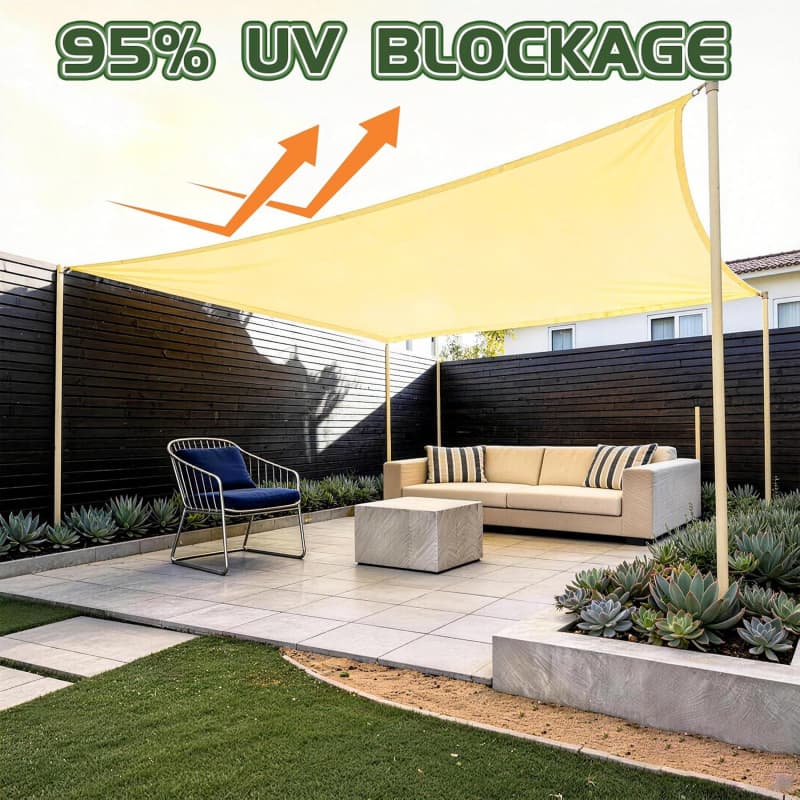
    Many people shop for a shade sail with one simple goal: block the harsh sun. They imagine a solid, dark cover that cuts out sunlight completely, turning their patio into a dim, static shelter. But HDPE shade sail works differently. It does not erase sunlight — it filters it. It is less like a rigid roof and more like a living light filter that paints shifting, soft shadows across your outdoor space as the sun travels across the sky.   This knitted HDPE mesh captures the magic of being outdoors while taming intense UV rays. Solid waterproof shade covers create one flat, heavy shadow. HDPE mesh breaks sunlight into dappled, gentle patterns. The shadows move, stretch and shift hour by hour, turning a plain pool deck, garden or courtyard into a dynamic, relaxing retreat. It keeps the open, airy feeling of being outside, rather than closing your space off.   What Makes HDPE Mesh Perfect for Light and Shadow?   Our shade sail is woven from virgin UV-stabilized HDPE yarn, formed into an open knitted structure with tiny uniform gaps. These gaps are the secret behind its signature light effect.   Sunlight passes through the mesh and scatters into soft diffused light. Harsh glare is removed, harmful UVA and UVB rays are blocked, yet you still get that warm, natural glow. Shade rates ranging from 85% to 95% let you control how much light filters through:   85% shade rate: More bright, dappled sunlight, ideal for gardens and casual lounge areas   90%–95% shade rate: Deeper, softer shade, great for pool decks and hot sunny zones   Unlike sealed waterproof fabric, which creates a single dark shadow and traps heat underneath, HDPE lets wind flow freely through the weave. Air circulates, hot air escapes, and the shaded area stays pleasantly cool. You get beautiful shadow art without the stuffy greenhouse effect.   Design Ideas: Use HDPE Shade Sails As Outdoor Art   Shade sails do not have to be limited to one single triangle stretched over a patio. Landscape designers, café owners and resort operators love layering multiple HDPE sails to craft unique shadow compositions.   Over a pool: Two overlapping triangular sails create flowing, changing shadows on the water surface.   Backyard lounge zone: One large rectangular sail for broad shade, paired with a smaller offset sail for layered light.   Garden beds: Soft speckled shade protects delicate plants from sunburn while still letting enough diffused light support healthy growth.   Commercial outdoor seating at cafes and boutique resorts: Staggered sails turn a simple seating area into an eye-catching feature that guests remember and photograph.   The curved-edge design of our HDPE sails keeps the fabric taut and smooth once installed, so the shadow pattern stays clean and consistent, free from messy wrinkles. Reinforced stitching and heavy-duty stainless steel D-rings at each corner hold tension steadily for long-term outdoor use.   Important: Light, Shadow, and Rain   This open mesh design is what creates those beautiful moving shadows, and it also means rainwater can pass straight through the fabric. HDPE shade sail is built for sun filtration, airflow and light play. It will not keep your space dry during rain.   That is why we also supply high-performance waterproof shade sails. Waterproof sails are the better pick for dining zones, outdoor kitchens and equipment storage where you need reliable shelter from light rain. Many of our customers combine both styles in one outdoor layout: HDPE sails for breezy, shadow-filled relaxation areas, and waterproof sails for spots where staying dry matters. They complement each other beautifully, rather than competing.   Extra Benefits Beyond Beautiful Shadows   While the shifting light is its most distinctive feature, the HDPE shade sail is still a tough, practical outdoor solution.   Low wind load: Wind passes through the mesh instead of pushing against the fabric like a solid parachute, making it safer for coastal, exposed and windy locations.   Naturally resistant to mildew and rot.   Lightweight and easy to take down, fold and store when not needed.   Simple maintenance: Rinse with fresh water to remove dust and leaves.   Flexible customization: Standard triangle, rectangle and square shapes in popular neutral tones, plus custom sizes, colors and GSM options for landscape and commercial projects.   Final Thoughts   A great outdoor space is not just about staying out of the sun. It is about connecting with the light, wind and changing weather around you.     HDPE shade sail turns basic sun protection into something artistic. It does not lock sunlight out. It rearranges it, casting slow-moving shadows that change from morning until dusk. If you love the feeling of open air, soft natural light and a visually dynamic backyard, pool or commercial space, this breathable HDPE shade sail is made for you. And if you also need a dry, rain-safe zone, our waterproof shade sail collection is ready to pair with it.  
    Read More
  • Shift Your Orchard Risk From Reactive Repair To Planned Protection
    Shift Your Orchard Risk From Reactive Repair To Planned Protection
    Oct 23, 2026
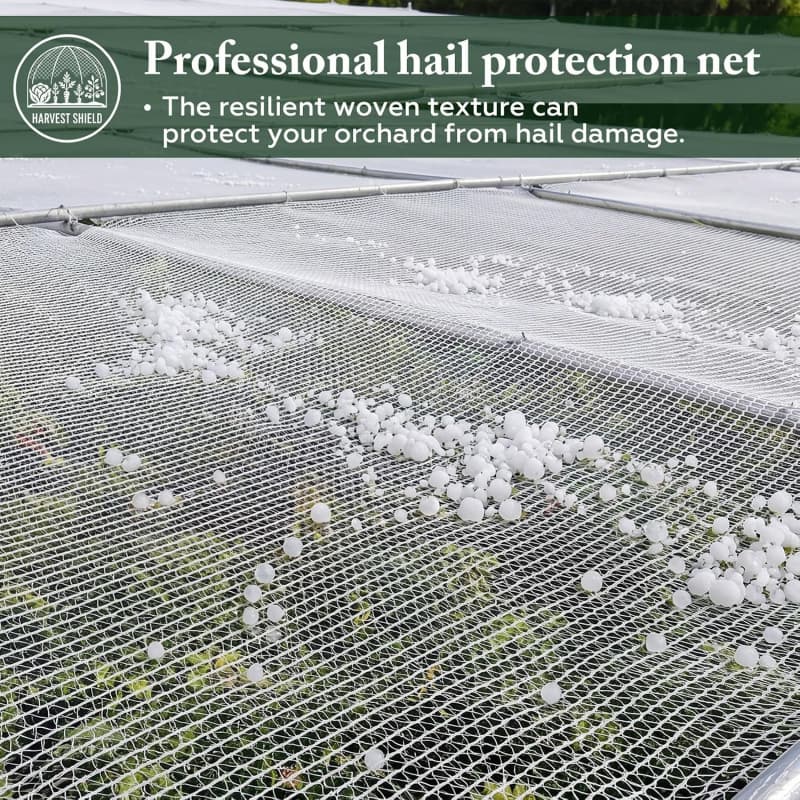
    Hail risk is a strange problem in commercial farming. Most growers accept it as random bad luck. They buy insurance, cross their fingers, and scramble to clean up after a storm hits. But this mindset locks your harvest into uncertainty year after year.   Anti hail net is not just another farm accessory. It is a risk-transfer tool built into your orchard layout. Instead of responding to damage after it occurs, you set up a passive overhead buffer that activates the moment hail starts falling. It does not eliminate extreme weather, but it removes the all-or-nothing gamble that defines hail-prone growing regions.   Many first-time buyers make the same mistake: they compare anti hail nets only by price per roll. Two nets can look almost identical in photos, yet behave completely differently under real hail impact, wind load, and multi-year sun exposure. The difference sits in yarn formulation, knitting structure, edge reinforcement, and how the whole net interacts with your support frame. This post breaks down the decision framework from a farm operation perspective, not just a product feature list.   The core logic: Anti hail net works through controlled deflection, not rigid blocking   A common misunderstanding is thinking the net “catches” hailstones like a bucket. That is not how it functions.   When a hailstone drops at high speed, the knitted mesh yields slightly, stretches locally, and disperses kinetic energy across many adjacent yarns. The stone either bounces away or fractures into tiny fragments with too little remaining force to injure fruit, leaves or young branches. The mesh recovers its shape afterward, ready for the next storm.   This flexible response is why anti hail net cannot be replaced by shade net, bird net or plastic film. Shade net is designed to filter light; its yarn is thinner and it lacks the elastic recovery needed for impact. Bird net uses fine openings and low tensile strength; it tears quickly under hail. Plastic sheeting stops hail but traps heat, blocks rain and airflow, and creates a hostile microclimate under the cover.   A well-engineered anti hail net strikes a narrow balance: strong enough to absorb impact, open enough to keep the canopy breathing, light enough for practical handling and installation.   The hidden economic value most buyers overlook   The clearest return on anti hail net comes from avoiding catastrophic fruit loss. But the real financial benefit unfolds in quieter ways across your farm operation. First, it stabilizes your sales grade profile. Premium fresh fruit markets penalize even tiny surface marks. One hailstorm can push a large share of your harvest from export grade down to processing grade, cutting revenue drastically. With consistent protection, you can lock in pre-season buyer contracts with more confidence, because you can reliably commit to quality standards. Second, it smooths your annual maintenance budget. Unprotected orchards face unpredictable costs: broken branch pruning, disease entry points from wounded tissue, replanting of young trees, and extra labour for sorting out damaged fruit. These costs do not show up on your material quote sheet, but they pile up fast after a bad storm. Third, it reduces secondary stress on trees. Hail wounds are easy entry points for bacteria and fungi. A net that limits physical bruising also lowers disease pressure and reduces the need for emergency spray schedules after storm events.   And finally, the same net brings secondary weather buffering. It softens gusty wind, reduces direct sun radiation on fruit skin, and discourages bird feeding during ripening windows. These gains are side effects, not the primary purpose, but they add measurable value in mixed-risk zones.   What to assess when comparing anti hail net options   When you evaluate samples from suppliers, move past “gsm only” comparison. Four factors together determine real-world performance.   1. Raw polymer base and UV package   Virgin HDPE is the baseline for consistent performance. Recycled HDPE blends contain inconsistent contaminants, which create weak spots in individual yarns. Even if the gsm reads the same on a scale, recycled net can develop brittle lines and split open after one or two seasons.   UV stabilizer loading is not a single standard. Nets sold for inland high-UV zones require a different additive package than nets for cooler, cloudy hail zones. A supplier that only quotes a generic “UV treated” label without linking expected service life to your local climate is giving you incomplete information.   2. Knitting structure and load distribution   Knotless construction delivers a smooth surface that reduces rubbing abrasion on fruit when the net shifts in wind. This is the preferred style for high-value cherry, apple and table grape blocks. Knotted net has locked intersections and higher resistance to tearing once a cut starts, making it better for sites with heavy wind, snow load, or rough seasonal handling.   Neither version is universally better. The right choice depends on what stress your location puts on the net most often: fruit contact abrasion, or high tensile pull.   3. Mesh opening size and light trade-off   Smaller openings improve hail interception but reduce light transmission. Larger openings preserve more sunlight and airflow yet leave you exposed to smaller damaging hail. There is no perfect mesh size for every crop. Light-sensitive varieties that need full colour development cannot tolerate overly dense mesh. Crops already fighting frequent sunburn can accept a slightly tighter mesh to gain dual protection. This is why a supplier should ask for your crop variety and typical hail size distribution before recommending a specification.   4. Edge finishing   Plain-cut edges are the weakest point of any net roll. Under tension, tears start at the edge and run rapidly across the mesh. Reinforced rope-in hems distribute pulling force evenly across anchor points. If you plan to install and remove the net year after year, reinforced edges are not an upgrade — they are a necessity.   Fit the net system to your farm rhythm   Anti hail net works best when you integrate it into your growing calendar, not treat it as a last-minute emergency cover.   For most deciduous fruit, the critical protection window opens after fruit set. Once young fruit forms, bruising risk begins. Installing too early can interfere with pollinator movement; installing too late leaves you exposed if an early hail event arrives. After harvest, you can roll the net away for storage if your frame system is designed for seasonal operation, or leave it mounted permanently for high-risk areas.   Frame design matters as much as the net itself. The net must hang freely above the canopy. If it lies directly on branches, hail energy transfers through the mesh into the fruit underneath, and wind movement creates constant rubbing damage. Sloped frames work better than flat tops because they shed rain and melted hail, avoiding heavy static load that can break fixings or stretch the mesh permanently.   Routine checks follow storm seasons. Look for small snags and nicks before they turn into large rips. A tiny repair takes minutes; a full panel replacement costs hours of labour and material.   Who gets the strongest ROI from anti hail net?   Anti hail net makes the most sense for operations built around high-value fresh market fruit. Cherry orchards are a classic fit because cherry skin is extremely fragile. Wine and table grape growers also benefit heavily, since berry damage ruins both appearance and fermentation quality. Apple, pear, stone fruit, citrus and kiwi operations in hail corridors see clear returns.     It is less common for low-margin bulk field crops, where the cost of frames and netting cannot be justified against commodity pricing. For these growers, alternative risk strategies may remain more economical.   Closing   Modern commercial farming is increasingly about managing volatility. Hail will not disappear, but you do not need to build your business around surviving its random hits. Anti hail net gives you a predictable layer of control that aligns with long-term orchard planning.     The best anti hail net purchase is not the cheapest roll you can source. It is a matched system: yarn spec, knit style, mesh dimension, edge treatment, frame layout and maintenance plan tailored to your crop and local weather patterns. When you get that combination right, you stop gambling on hail seasons and start protecting the harvest you have worked all year to grow.  
    Read More
  • What Is Anti Insect Net and How Does It Work
    What Is Anti Insect Net and How Does It Work
    Oct 22, 2026
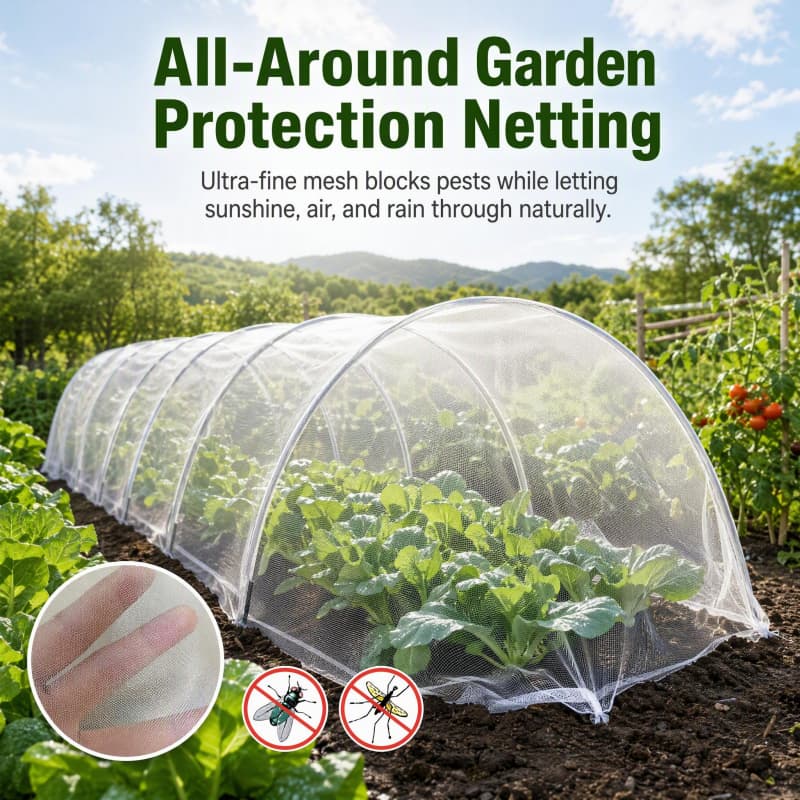
    Every season, growers lose a quiet slice of their harvest not to disease or drought, but to insects small enough to slip past the naked eye. Aphids, thrips, whiteflies and caterpillars feed, lay eggs and spread viruses faster than most sprays can catch up. Anti insect net offers a simpler, chemical-free answer: a physical barrier that keeps pests out without keeping rain, air or sunlight out. This guide breaks down what the product actually is, the engineering behind it, and why it outperforms pesticide routines on cost, safety and crop quality.   What Is Anti Insect Net   Anti insect net, also called insect netting, insect proof net or bug net, is a fine mesh fabric woven from polyethylene (PE) monofilament, designed to block insect pests from reaching crops while letting light, water and air pass through. It is stretched over greenhouses, tunnels, raised beds or whole trees to create a physical shield between the plant and the pest. The product is not a film and not a cloth — it sits somewhere between. The mesh structure is open enough to be breathable, but tight enough to keep out target insects. Because it works by exclusion rather than by poison, it fits organic farming, seedling nurseries, fruit orchards and commercial vegetable bases alike.   How It Works   Anti insect net works on one principle: size exclusion. The mesh opening (measured in mesh count) is smaller than the body of the target pest, so the insect simply cannot pass through. Three factors make the barrier effective: Factor What it does Why it matters Mesh count Number of threads per inch, e.g. 40 mesh, 50 mesh Determines the smallest pest blocked; higher mesh stops smaller insects UV-stabilized HDPE thread Resists sunlight degradation Keeps the barrier intact outdoors for 3–5 years Tight installation Net pulled taut and sealed at edges Closes the gaps pests would otherwise find   Because the net is physical, it works 24 hours a day with no residue and no re-application. It does not rely on the pest being present to act — it prevents entry in the first place.   Mesh Size Matters More Than You Think   Choosing the right mesh count is the single most common mistake buyers make. Too fine a mesh blocks small pests but reduces airflow and light; too coarse a mesh lets the target pest through. Match the mesh to the specific insects in your region:   Mesh count Typical opening Blocks Best suited for 20 mesh ~1.0 mm Larger insects, flies, moths, birds Orchard, fruit tree, coarse screening 32 mesh ~0.6 mm Whiteflies, most moths Greenhouse vegetables 40 mesh ~0.44 mm Aphids, thrips Tomatoes, peppers, cucumbers 50 mesh ~0.36 mm Thrips, smaller aphids Seedling nursery, high-value crops 60 mesh ~0.28 mm Minute pests incl. thrips Germination and young seedling trays   A common recommendation: 40–50 mesh for leafy vegetables and solanaceous crops, 60 mesh for seedling trays where young plants are most vulnerable to thrips.   Why Physical Barrier Beats Pesticide Routine   Growers often ask why they should switch when insecticide has worked before. The comparison rarely favours spraying:   Zero chemical residue. No withholding period, no risk of eating produce too soon after application.   No resistance build-up. Insects develop resistance to pesticides over seasons; a net does not change, so it never stops working.   One-time setup, repeated seasons. A net installed once serves multiple crop cycles, where insecticide is a recurring cost.   Broader protection. It also keeps out birds, wind-blown debris and some fungal vectors, not just insects.   Predictable cost. Upfront price is the main spend; running cost is essentially zero.   This is why organic and export-grade produce operations rely on insect netting as a first line of defence rather than a supplement to chemicals.   Material and Durability   Not all anti insect net is built the same. The quality difference sits in two areas: raw material and UV stabilisation.   HDPE (high-density polyethylene): the standard choice. It is light, tear-resistant, waterproof and holds its shape under tension.   UV-stabilised grade: added light stabilisers slow sun degradation. Plain netting can become brittle and tear within one season outdoors; a UV-stabilised version typically lasts 3–5 years under full sun.   Breathability: the open weave allows air circulation, which reduces humidity and the risk of fungal disease — an advantage sealed plastic covers cannot offer.   If the net will sit under strong sunlight or across multiple seasons, UV-stabilised HDPE is the practical choice.   FAQ   Does anti insect net block pollinators like bees? Not necessarily. For crops that need insect pollination, choose a mesh count coarse enough (e.g. 20–32 mesh) or remove the net during the flowering window. Fine mesh blocks bees as well as pests, so plan the schedule around pollination.   Can water pass through the net? Yes. Rain and overhead irrigation pass through the open weave freely, so you do not need to remove it for watering.   How long does HDPE insect net last outdoors? UV-stabilised HDPE typically lasts 3–5 years in full sun; non-UV grades degrade faster, often within a single season. Durability depends on sun intensity and installation tension.   Can I cut anti insect net to a custom size? Yes. It cuts cleanly with scissors or a hot knife, and edges can be heat-sealed or taped to prevent fraying.   Is anti insect net the same as mosquito net? No. Mosquito netting is finer, designed for home windows, and too dense for good greenhouse ventilation. Anti insect net is optimised for crops: balanced mesh, UV resistance and outdoor durability.  
    Read More
  • Why Aluminum Shade Net Is a Top Pick for Pet Outdoor Shade
    Why Aluminum Shade Net Is a Top Pick for Pet Outdoor Shade
    Oct 21, 2026
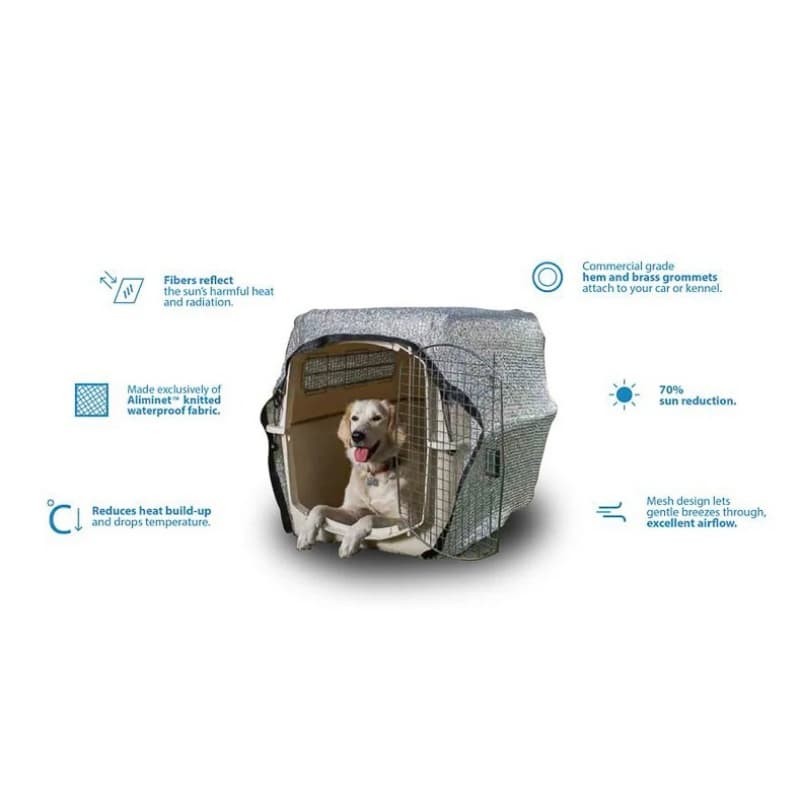
    Summer heat and strong UV radiation are big safety concerns for pets that spend time outdoors. Dogs, cats, rabbits and other companion animals can suffer heatstroke, sunburn and skin damage quickly under direct sun.   We supply both aluminum shade net and standard HDPE shade net. Neither one is universally “better”. Each works well in different scenarios. Today we focus on why many pet owners, kennel operators and breeders choose aluminum shade net for their pet spaces, while also sharing when regular shade net remains a practical choice.   How Aluminum Shade Net Works for Pets   Regular HDPE shade net blocks sunlight by absorbing part of the solar rays. Aluminum shade net works differently: it uses a metallized aluminum coating to reflect infrared heat and UV radiation away from the shaded zone, instead of soaking up heat into the fabric itself.   Its knitted open mesh structure still keeps good airflow. That combination is the core reason it shines for pet shading.   Key Benefits for Pet Enclosures, Kennels & Dog Runs   Strong radiant heat reduction — lower risk of heat exhaustion Even with the same shade percentage, aluminum shade net can create a noticeably cooler microclimate underneath. On hot sunny days, the ground, kennel roof and air under the net stay cooler because radiant heat bounces away, rather than being trapped. This is extremely valuable for flat-nosed breeds, senior pets, puppies and animals prone to overheating.   High UV blocking to protect pet skin Many pets have thin fur, light-colored coats or exposed skin on ears and noses. Chronic UV exposure leads to sunburn and long-term skin issues. Aluminum shade net delivers reliable UV block while producing soft, diffused light instead of harsh, dark shadow. Pets still get gentle daylight without intense burning rays.   Balanced airflow, no stuffy shelter A common worry with reflective coverings is poor ventilation. Aluminum shade net is not a solid foil sheet. It is a knitted mesh, so wind passes freely through the fabric. Air exchange continues normally, which stops hot, stagnant air building up inside dog houses, runs or cattery areas.   Year-round flexible performance In summer, it reflects solar heat to cool the pet zone. On cool, clear nights, the aluminum layer acts as a mild thermal barrier and slows heat loss. That makes it suitable for use in regions with big day-night temperature swings, not just hot summer months.   Durable, corrosion-resistant for outdoor pet areas The aluminum coating paired with UV-stabilized base fiber stands up to rain, humidity and coastal salt spray better in many cases. Reinforced edges and pre-punched grommet options make it easy to mount over kennels, play yards and patio pet spaces.   Regular HDPE Shade Net: Still a Great Option (We Sell It Too)   We want to be clear: regular HDPE shade net is not a poor product. It has its own strengths and fits many pet budgets and use cases perfectly.   More cost-effective upfront for large coverage areas   Wide range of shade rates (30% to 95%) and colors to pick from   Lightweight, flexible, simple to reposition or take down seasonally   Great for temporary shade, backyard casual use, short-term shelters and projects with tighter budgets   The main difference: standard shade net absorbs some heat. On extremely hot, high-radiation days, the fabric itself will warm up and release stored heat slowly back into the shaded space below. For mild climates, shaded backyards or short-duration pet outdoor time, it works reliably.   Quick Comparison Guide for Pet Owners   Item Aluminum Shade Net Regular HDPE Shade Net Heat control Reflects infrared radiation; best for extreme hot sun Absorbs sunlight; good for moderate heat Light effect Soft diffused light Darker shadow depending on color/shade rate Airflow Good open mesh airflow Good airflow Best fit Kennels, permanent pet runs, hot climate, heat-sensitive pets Casual backyard shade, temporary use, budget projects Price Higher Lower   Which One Should You Choose for Your Pets?   Pick aluminum shade net if:   You live in a hot, sunny area with strong radiant heat   Your pets stay outdoors for long hours   You have flat-faced breeds, senior pets or pets with sun-sensitive skin   You need a fixed kennel / cattery cover that works all year round   Pick regular HDPE shade net if:   You only need temporary or seasonal shade   Your pets go outside for short periods   You have a limited budget and mild summer heat   You prefer multiple color choices to match your yard   Final Words   Pet safety always comes first when designing outdoor shade. Aluminum shade net has earned popularity among pet keepers because of its unique reflective cooling mechanism, which directly targets the biggest risk: radiant heat.   At the same time, regular HDPE shade net remains a trusted, economical solution for many pet shade projects. We stock both types in multiple shade percentages and custom cut sizes, so you can match the right net to your climate, pets and budget.   If you are unsure which shade rate or material suits your kennel layout, send us your dimensions and local weather notes — we can help you select the right option.   FAQ   Q: Does aluminum shade net block all sunlight? A: No. It is available in different shade rates. It diffuses light and reflects most infrared heat instead of creating total darkness.   Q: Is aluminum shade net heavy for kennel installation? A: No. It is lightweight knitted mesh, easy to hang with ropes, bungee cords or cable ties using the built-in grommets.   Q: Can regular shade net prevent pet heatstroke? A: It reduces direct sun exposure, but its heat absorption property means it is less effective under extreme, prolonged high heat. Always keep fresh water and monitor pets on hot days, no matter which shade net you use.  
    Read More
  • Aluminum Shade Net vs Regular HDPE Shade Net: How to Pick the Right Shade Mesh for Your Project
    Aluminum Shade Net vs Regular HDPE Shade Net: How to Pick the Right Shade Mesh for Your Project
    Oct 20, 2026
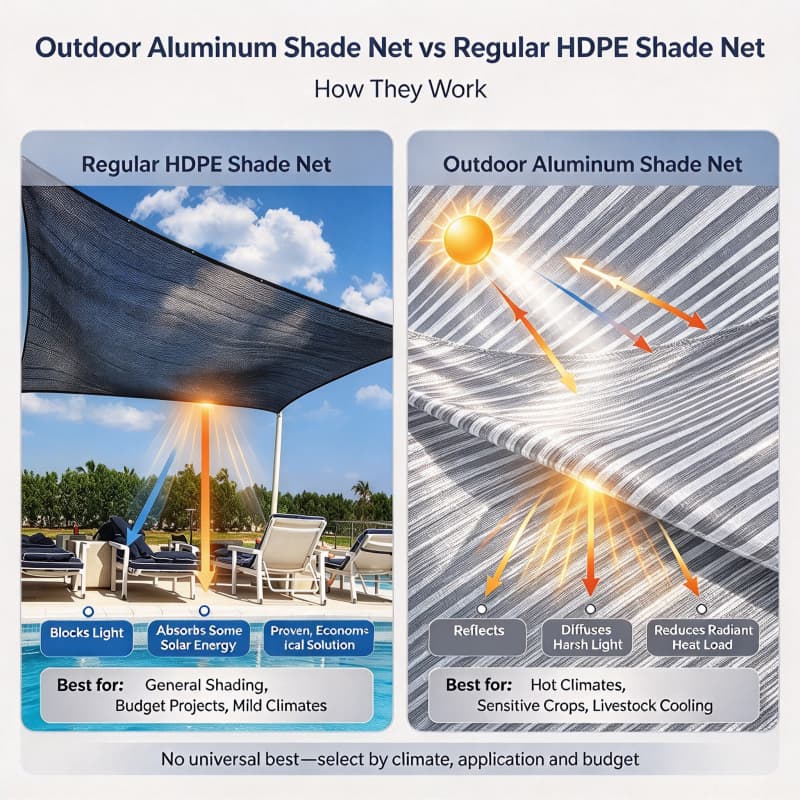
    Introduction   When planning outdoor shading for greenhouses, patios, livestock barns or construction sites, shade net is one of the most cost-effective solutions. Two mainstream options dominate the market: aluminum reflective shade net and regular HDPE shade net. A common misunderstanding is that one type is universally “better”. In reality, each works on a different physical principle and fits distinct project priorities. We supply both aluminum shade net and standard HDPE shade net. Our goal here is to lay out factual differences, so distributors, farmers and contractors can select based on climate, crop type, budget and expected service life.   How They Work: Core Principle Difference   Regular HDPE Shade Net   Standard shade net is knitted from HDPE yarn mixed with UV stabilizers. It works by absorbing sunlight and blocking a set percentage of light. The fabric absorbs solar energy and releases part of that heat into the space underneath. It is a mature, proven shading solution widely used globally for decades.   Outdoor Aluminum Shade Net    Aluminum shade net uses UV-stabilized HDPE base mesh bonded with aluminum reflective filaments. Instead of absorbing solar heat, it reflects infrared radiant heat and UV back to the atmosphere. It still filters light, but creates a cooler microclimate by reducing radiant heat load, while diffusing harsh direct sunlight into soft, even light. It also offers mild heat retention overnight in greenhouse applications.   Side-by-Side Comparison Table   Comparison Item Regular HDPE Shade Net Outdoor Aluminum Shade Net Working Mechanism Absorbs sunlight to block light; some heat re-radiates downward Reflects infrared & UV radiation; diffuses incoming light Cooling Performance Provides shade; temperature drop is limited Superior radiant heat reduction; noticeably cooler under the net under strong sun Light Quality Creates sharp shadows; light distribution less uniform Soft diffused light; fewer hot spots, better for sensitive crops Material & Structure Pure HDPE knitted mesh HDPE base + aluminum reflective coating/filaments Upfront Cost Lower Higher Service Life Good with virgin HDPE and UV additives Long service life in hot high-radiation areas; aluminum layer needs protection from heavy abrasion Night Thermal Performance No thermal retention Minor heat retention for greenhouse overnight Best Fit Temporary shading, low-budget projects, mild climates, general shading Hot climates, temperature-sensitive crops, livestock cooling, premium patio & long-term commercial shading   Benefits & Limitations of Regular HDPE Shade Net   Strengths   Budget-friendly for large-area or short-term shading projects   Simple product with stable supply and easy installation   Wide range of shade rates and colors (black, white, green)   Good tensile strength and wind resistance for general use   Easy to cut, re-use and store for seasonal jobs   Limitations   Absorbs heat, so under-canopy temperature rises more in extreme heat   Creates concentrated shadow areas, may cause sunscald on delicate crops   Benefits & Limitations of Outdoor Aluminum Shade Net   Strengths   Reflective cooling: same shade rate delivers stronger temperature reduction in intense sunlight   Even diffused light reduces hot spots and crop sunburn   Blocks UV while maintaining airflow   Dual function: daytime cooling + slight night heat preservation for greenhouses   Ideal for high-value crops, animal heat stress relief and residential patio comfort   Limitations   Higher initial investment compared with standard HDPE shade net   Aluminum reflective surface can wear if subject to heavy friction or sharp abrasion   Metallic silver appearance may not fit every landscape aesthetic preference   How to Choose: When to Pick Which   Choose Regular HDPE Shade Net if:   You have a tight budget or temporary shading (construction covering, seasonal event shading)   Your local climate has mild summers without prolonged extreme heat   You need simple light blocking for hardy plants, general farm coverage   Large area coverage where upfront cost is the primary deciding factor   Choose Outdoor Aluminum Shade Net if:   Projects located in hot, high UV regions where radiant heat is a major concern   Greenhouse cultivation for sensitive, high-value crops (nursery seedlings, flowers, berries)   Livestock barns, poultry houses to reduce heat stress and protect animal productivity   Residential pergolas, carports, pool areas where human comfort is key   Long-term fixed installations, and you want to lower ongoing crop/asset heat damage   Frequently Asked Questions   Q1: For the same shade percentage, will aluminum shade net always be cooler? A1: Yes for radiant heat. Under strong direct sunlight, aluminum shade net delivers better cooling effect. But airflow, installation gap and local weather also affect the final temperature. Regular HDPE shade net still works reliably for basic shading.   Q2: Can I mix the two types in one greenhouse project? A2: Absolutely. Many clients combine them: use aluminum shade net for sensitive crop zones and standard HDPE shade net for outer roof or low-priority areas to balance performance and budget.   Q3: Are both products customizable? A3: Yes. We supply custom width, length, shade rate, reinforced edges and grommet options for both regular HDPE shade net and aluminum shade net.   Q4: What about wind resistance? A4: Both are breathable knitted mesh and suitable for outdoor wind conditions. Proper tension and mounting are critical regardless of the shade net type you select.   Conclusion   There is no universal “best” shade net, only the most suitable one for your specific project. Regular HDPE shade net remains a practical, economical staple for most standard shading needs. Aluminum shade net is a performance upgrade, designed specifically for hot climates and applications where precise temperature control matters.   We carry both product lines. Share your location, application, shade rate requirement and budget, and our team can recommend the optimal mesh solution for wholesale or project orders.
    Read More
  • Why 60% Shade Net Is The Most Versatile Shading Choice For Growers
    Why 60% Shade Net Is The Most Versatile Shading Choice For Growers
    Oct 19, 2026
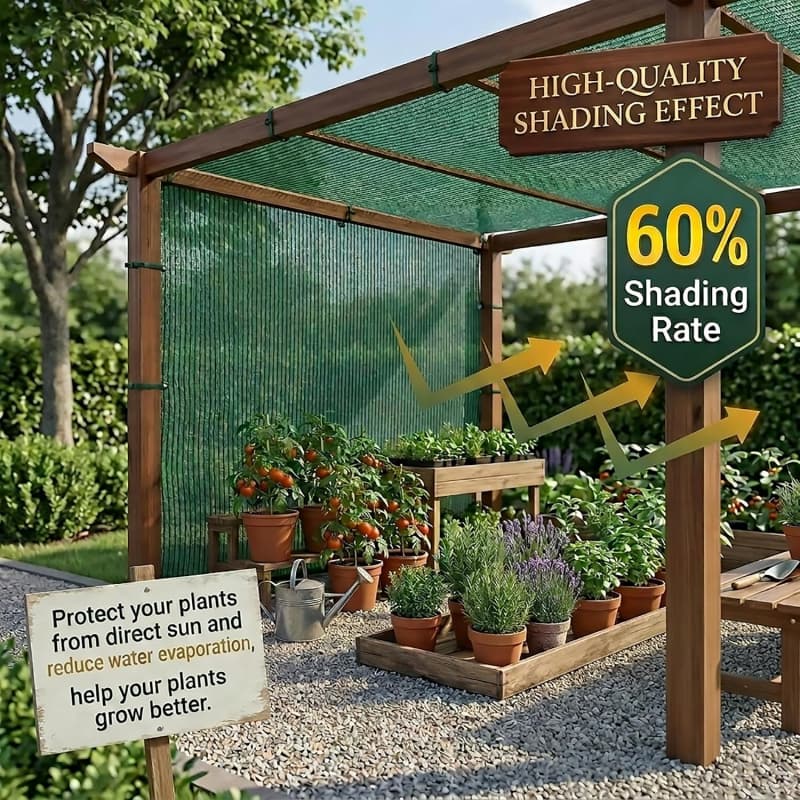
    Choosing the correct shade rate can make or break your growing season. Many growers either pick 30% shade net which offers barely enough heat relief in hot summers, or jump straight to 70%–80% heavy shade net that limits photosynthesis and leaves plants weak and leggy.   If you are searching for a balanced shading solution that cuts harsh sun without starving plants of light, 60% shade net is your sweet spot. It has become the go-to choice for commercial nurseries, vegetable farms, orchard operators, livestock owners and home gardeners worldwide.   What Exactly Is 60% Shade Net?   60% shade net blocks 60% of direct sunlight and harmful UV radiation, while letting 40% soft diffused light pass through. Made from UV-stabilized virgin HDPE yarn with raschel warp-knitted structure, this mesh does not fully darken the covered area. Instead, it scatters harsh direct sunlight into gentle diffused light.   Unlike solid tarps that trap heat and stop airflow, shade net remains permeable. Air and rain can freely flow through the mesh openings, preventing overheating and water pooling underneath.   The Top Benefits of 60% Shade Net   1. Prevents leaf burn while maintaining healthy plant growth   Strong midday sun easily scorches tender seedlings, leafy greens and ornamental flowers. The 60% shading level shields foliage from UV damage. Meanwhile, the remaining 40% transmitted light is sufficient for photosynthesis. This avoids the common issue of elongated, weak stems caused by over-shading.   2. Reduces ambient temperature and saves water   Direct sunlight heats soil rapidly and speeds up moisture evaporation. When covered with 60% shade net, the microclimate under the cover stays several degrees cooler. Less soil drying means you can cut down irrigation frequency and reduce water costs, a huge advantage for large-scale farms in hot and arid regions.   3. Durable outdoor performance for year-round use   Our 60% HDPE shade net mixes UV masterbatch into yarn, not just surface coating. It resists aging, fading and brittleness under long-term outdoor exposure. The lock-stitch knitted design stops the mesh from unraveling even after small tears, delivering excellent tear and wind resistance.   4. Multi-scene application beyond plant growing   60% shade net is not limited to greenhouses and nurseries:   Livestock shelters: Protect cattle, chickens and other animals from heat stress in summer   Orchards & berry farms: Shield fruit from sunscald   Residential patios, carports: Create comfortable shaded outdoor leisure zones   Construction sites: Temporary UV protection for workers and materials   Which Crops Suit 60% Shade Net Best?   This shade rate works wonderfully for crops that prefer partial sunlight:   Seedlings, saplings and young plants   Leafy vegetables: lettuce, spinach, herbs   Ornamental plants: ferns, anthurium, orchids   Berries and young fruit trees   Tip: High-light crops such as tomatoes and peppers usually require lower shade rate (30%-40%). For full-shade plants like mushrooms, choose 70%+ shade net.   Key Buying Checklist Before You Order 60% Shade Net   1.Confirm the shade rate tolerance: Reliable manufacturers keep tolerance within ±5%   2.Check raw material: Virgin HDPE with UV additives lasts much longer than recycled material   3.Choose finishing: Reinforced hems and grommets are recommended for repeated installation   4.Measure your frame: Calculate width and length accurately; leave extra margin for tensioning.   Simple Installation Tips   Stretch the net moderately; avoid excessive tension which may damage the mesh in strong winds.   Keep a gap between the net and plant canopy to retain airflow.   Secure firmly onto posts, cables or greenhouse frames.   Clean and dry the net fully before storage to extend service life.   Final Thoughts   Shade net is never a one-size-fits-all product. Among all available shade rates, 60% strikes an ideal balance between sun protection and light transmission. It solves heat stress and sunburn problems without sacrificing plant vitality.   Whether you run a commercial nursery, manage a farm, or just want a shaded patio space, 60% HDPE shade net delivers reliable, cost-effective protection for all your outdoor projects.   If you need custom sizes, colors or pre-grommeted panels, contact our team for wholesale quotations and samples.   \  
    Read More
  • Black HDPE Shade Net: Busting Heat Myths & The Ultimate Multi-scenario Shading Solution
    Black HDPE Shade Net: Busting Heat Myths & The Ultimate Multi-scenario Shading Solution
    Oct 16, 2026
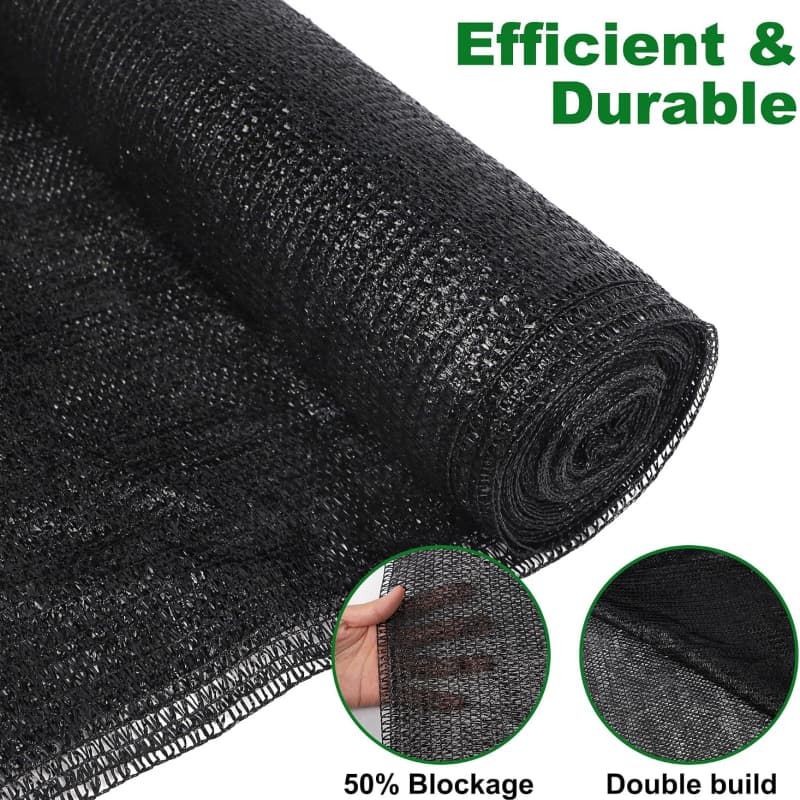
    When buyers compare shade net options, one question always comes up: Will black shade net trap heat and make the space below hotter?   This persistent misunderstanding stops many growers, contractors and distributors from picking black shade mesh — even though it remains the world’s most popular, cost-effective shading material for agriculture, construction and residential outdoor shading.   Black HDPE shade net, also called black sun shade net or black shade cloth, delivers balanced UV blocking, uniform light diffusion and extra privacy. Made from knitted virgin HDPE yarn mixed with UV stabilizers, it is engineered to handle year-round harsh outdoor exposure. In this guide, we break down its real performance, use cases, shade rate selection and key buying tips for global buyers.   Why Black Shade Net Is Different: The Heat Myth Explained   Black fibers absorb solar radiation mostly on the surface of the net itself, rather than letting scorching direct sunlight penetrate down to crops, livestock or work zones. Thanks to its open knitted mesh structure, air and rain can freely flow through the holes. Hot air will dissipate quickly instead of accumulating under the cover.   That said, it is important to understand its strength:   Blocks harmful UVA & UVB rays evenly   Creates soft diffused light for plants   Delivers privacy screening besides sun shading   Consistent shading rate across the whole roll   For tropical, high-UV regions, black shade net is widely trusted for nurseries, livestock shading and construction dust control. For extreme hot climate greenhouse projects, buyers can evaluate between black and aluminet shade net based on crop requirements.   Core Advantages of Our Black HDPE Shade Net   Long-Lasting UV Stabilized Virgin HDPE Material UV additives are blended into yarn during extrusion, not just sprayed on the surface. This avoids peeling or fast aging. Under normal outdoor conditions, service life reaches 5–8 years, resistant to strong sun, rain and wind. Raschel knitted structure prevents small tears from spreading quickly.   Wide Range of Custom Shade Rates Available from 30% up to 90% shade density. We can customize width from 1m to 12m and unlimited roll lengths. Optional reinforced stitching, bound edges and rust-proof metal grommets for fast installation on large spans. OEM logo printing is available for bulk orders.   Lightweight, Breathable & Water Permeable Rainwater drains through without pooling on top. Air circulation reduces mold risk for plants. It is flexible and foldable for simple transport, storage and repeated installation.   Multi-functional for 4 Major Markets One black shade net serves multiple verticals, perfect for wholesalers to expand product portfolio.   How To Choose The Right Shade Percentage   30%–40%: Tomatoes, peppers and other fruiting vegetables. Reduces sunburn without cutting down too much sunlight needed for yield.   50%: General farm, vegetable beds, livestock cooling cover. Balanced choice for most growers.   60%–70%: Seedlings, flowers, sensitive nursery plants. Protect tender foliage from leaf scorch.   80%–90%: Construction dust control, privacy screening, carport shading, animal pens, waste material covering.   Common Applications of Black Shade Net    Agriculture & Horticulture Greenhouse roof shading, seedling nursery, orchard, vegetable farms, livestock cooling cover for poultry, cattle and sheep pens.    Residential Outdoor Patio, pergola, backyard privacy screen, carport sun protection, swimming pool surrounding shading. Construction & Industrial Scaffolding shade, site dust suppression, temporary privacy fence, outdoor material protection cover.   FAQ    Q1: Should I pick black, green or silver shade net? Black gives consistent light filtering and the best privacy at competitive pricing. Silver/aluminet reflects heat and works best for ultra-hot commercial greenhouses. Green is more for garden aesthetic.   Q2: What’s the difference between knitted and woven shade net? Raschel knitted shade net is tear-resistant and widely used for outdoor shading. Woven net is stiffer, less flexible and more often for heavy duty industrial covering. Our black shade net uses knitted construction.   Q3: How to install black shade net properly? Leave a small air gap between net and the surface below. Good airflow will maximise cooling performance. Use grommets and cable ties to fix it loosely, avoid over-tensioning in hot weather.   Q4: Can I get samples before bulk purchase? Yes. We provide small swatch samples for quality testing; buyers only cover courier freight. Flexible MOQ and factory wholesale pricing for distributors and project contractors.   Conclusion   Black HDPE shade net remains a reliable, versatile shading solution for global buyers. It is not just a cheap sun cover; it is a climate management tool for crops, a privacy barrier for construction sites and a simple cooling solution for outdoor living spaces. The key is selecting the correct shade rate, GSM and edge finishing according to local climate and project type. If you are a distributor, farm owner or construction contractor looking for bulk black shade net with custom specifications, contact our team today for wholesale quotation and sample support.  
    Read More
  • A Complete Guide for Greenhouse, Farm and Nursery
    A Complete Guide for Greenhouse, Farm and Nursery
    Oct 15, 2026
    Green Shade Net: A Complete Guide for Greenhouse, Farm and Nursery   Extreme sunlight, heat stress and crop sunburn are common headaches for growers across hot climates. Green shade net, also known as green shade cloth or green shade netting, has become one of the most cost-effective and versatile crop protection solutions for modern agriculture, nurseries and outdoor shading projects. Made of UV-stabilized HDPE material, this knitted shade mesh balances light filtration, air circulation and temperature control to support healthier plant growth.   What Is Green Shade Net?   Green shade net is a knitted mesh fabric manufactured from 100% virgin high-density polyethylene (HDPE), mixed with UV stabilizer additives during production. The green colour is not only aesthetic; it mimics natural tree canopy, delivering a balanced light spectrum for photosynthesis. Unlike solid tarps, the open mesh structure keeps air and rainwater passing through, avoiding trapped heat and moisture buildup under the cover. It is available in multiple shade percentages: 35%, 50%, 60%, 70%, 75%, 90%. Custom widths, lengths and finished edges with grommets can be produced for bulk orders.   Key Benefits of Green HDPE Shade Net   Reduce heat stress and sunscald Green shade net filters intense UV rays and lowers ambient temperature under the cover. It prevents leaf burn and fruit sun damage for seedlings, vegetables and flowering plants, extending growing seasons in hot regionsAlibaba.co....   Save irrigation water By cooling soil and slowing surface evaporation, green sun shade net cuts down water consumption significantly. This advantage is especially valuable for dry, water-limited farmland and nursery operations.   Breathable & weather-resistant Raschel knitted construction offers great tear resistance. Rain and wind can flow through freely. It will not rot or hold water like non-porous plastic sheets. UV stabilizer treatment protects the net from long-time sun exposure, extending service life outdoors.   Wide application flexibility Green shade net works for agriculture and non-agricultural shading projects. It blends naturally into farm and garden landscapes.   Main Applications of Green Shade Netting   Greenhouse covering and roof shading   Vegetable farms, fruit orchards and open field crops   Plant nurseries, seedling beds and flower cultivation   Livestock and poultry shed sun shelter   Fish pond shading to suppress algae growth   Garden, patio, car parking outdoor sun protection   Temporary construction shade and privacy screen   Quick Shade Percentage Selection Guide   35%–50% shade: Leafy vegetables, herbs, most flowering plants, young seedlings   60%–70% shade: Shade-loving plants, ferns, medicinal plants, nursery stock   75%–90% shade: Mushroom cultivation, heavy shade requirement for sensitive crops or animal shelters   Tip: Shade percentage is more important than colour when choosing shade net. Green shade net transmits a plant-friendly light spectrum, which makes it a top pick for nurseries and mixed crop farms compared to black shade net.   What to Check Before Buying Wholesale Green Shade Mesh   When sourcing green shade net for bulk purchase, focus on these specifications:   Material: Virgin HDPE + UV stabilizer (recycled material has much shorter lifespan)   Shade rate: Confirm exact shade percentage to match your crops   Knitting type: Raschel knit for high tensile strength and anti-tear performance   Size: Roll width, roll length, custom cutting, hemmed edges and grommet options   GSM: Gram weight directly relates to durability and service life   Packing & MOQ: Roll packing for easy transport, flexible MOQ for distributors   FAQ   Q1: How long does UV stabilized green shade net last outdoors? Premium HDPE green shade net with UV additives can serve 5–8 years under continuous full sunlight. Service life depends on local UV intensity, wind and installation method.   Q2: Can green shade net reduce hail damage? It provides partial protection against light hail and strong wind, though it is not a professional heavy hail net.   Q3: Is green shade net reusable? Yes. It is lightweight and flexible. You can remove, fold and store it after growing seasons for repeated use.   Q4: Can I get custom size green shade net rolls? Yes. We support custom width, length, pre-hemmed and grommeted green shade net for wholesale orders.   Final Words   Green shade net is a practical, low-investment solution to improve crop yield, reduce water usage and protect plants from harsh sun exposure. Whether you are a farm owner, greenhouse operator, nursery manager or shade net distributor, selecting proper UV stabilized HDPE green shade net with correct shade percentage brings long-term value to your project.   Contact us for wholesale pricing, free samples and customized green shade mesh solutions.
    Read More
1 2 3 4 5 6 7 8 9 10 13 14
A total of14pages

leave a message

leave a message
If you are interested in our products and want to know more details,please leave a message here,we will reply you as soon as we can.
submit

Home

Products

whatsApp

contact